An Assessment of the Microfinance Product Mix in Support of Small-Scale Businesses: A Case of Choma District, Zambia (Journal of economics, business and commerce.)
Summary
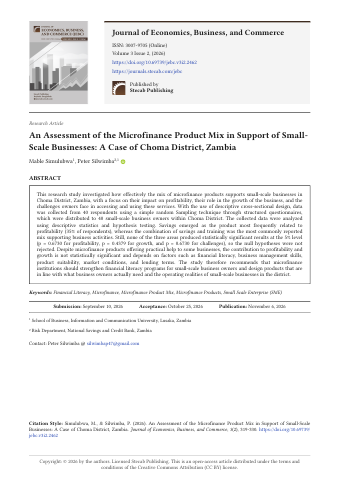
- Data was collected from a sample of 40 small-scale business owners in Choma District using simple random sampling through structured questionnaires.p.1
- Savings emerged as the financial product most frequently linked to business profitability, cited by 35% of respondents.p.1
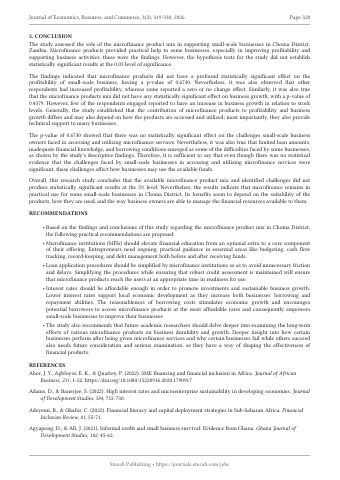
- Hypothesis testing indicated no statistically significant results at the 5% level for profitability (p = 0.6730), business growth (p = 0.4379), or operational challenges (p = 0.6730).p.1
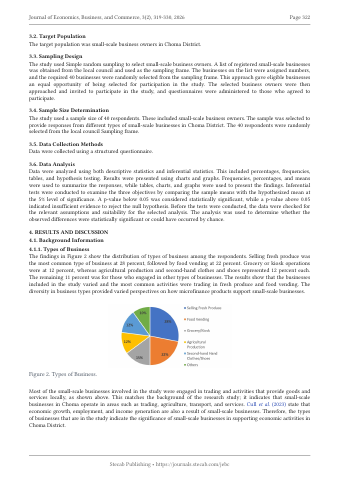
- Selling fresh produce was the most prevalent business activity among respondents at 28 percent, followed by food vending at 22 percent.p.5
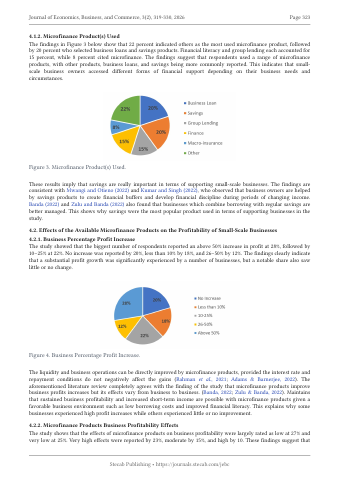
- Regarding profit increases, 28% of respondents reported profit growth above 50%, while 20% experienced no profit increase.p.6
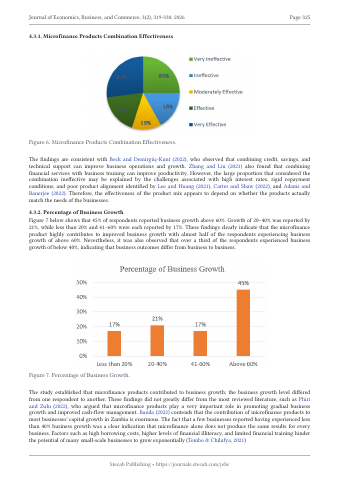
- In terms of business growth, 45% of respondents recorded expansion above 60%, whereas over one-third reported growth below 40%.p.8
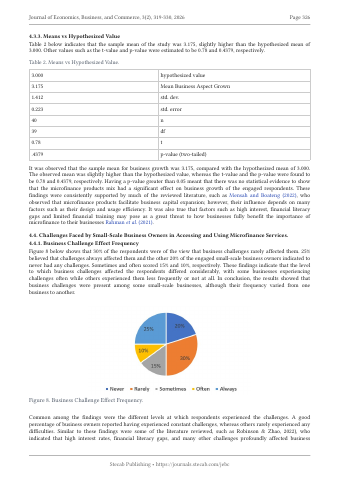
- When assessing challenge frequencies, 30% of business owners noted that challenges rarely affected them, while 25% stated that challenges always affected them.p.9
Key insights
- Hypothesis testing for profitability effects resulted in a sample mean of 3.100 against a 3.000 hypothesized value, with a z-value of 0.42 and p-value of 0.6730.p.7
- Evaluation of business growth yielded a sample mean of 3.175, a t-value of 0.78, and a p-value of 0.4379, failing to show a statistically significant impact.p.9
- The hypothesis test for business challenges showed a sample mean of 2.900, a z-value of -0.42, and a p-value of 0.6730, indicating no statistically significant difference from the hypothesized mean.p.10
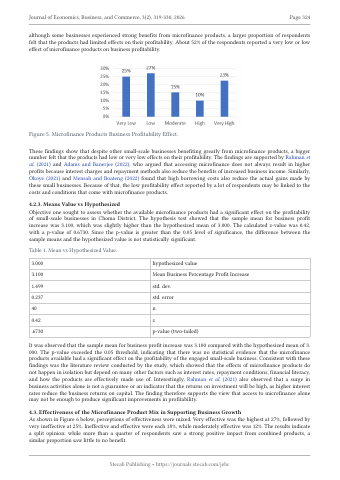
- Perceptions regarding the effectiveness of combined microfinance products were divided, with 27% rating them as very effective and 25% as very ineffective.p.7
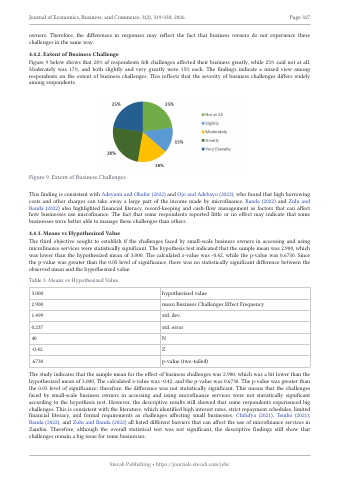
- While 28% of respondents felt business challenges impacted their enterprise greatly, 25% reported experiencing no impact at all.p.10
Pages
 p.1
 p.2
 p.3
 p.4
 p.5
 p.6
 p.7
 p.8
 p.9
 p.10
 p.11
 p.12
 p.13
Topics and entities
Summary and figures generated from the document and checked automatically: every number shown appears on the cited page. Publishers can request removal.