AI-Driven Predictive Analytics Framework for Financial Fraud Detection in Digital Transactions (International Journal of Intelligent Systems and Data Science)
Summary
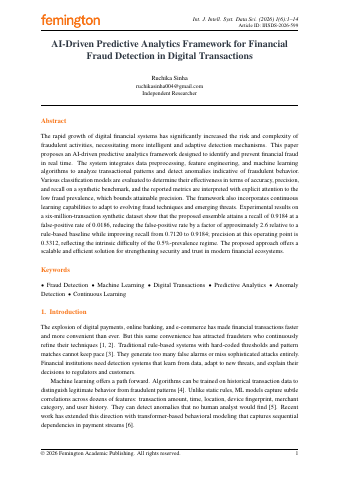
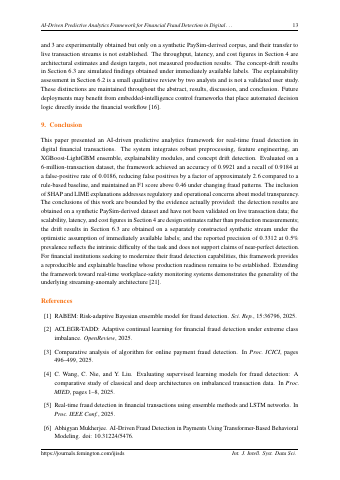
- On a six-million-transaction synthetic dataset, the proposed ensemble attains a recall of 0.9184 at a false-positive rate of 0.0186.p.1
- The framework reduces the false-positive rate by a factor of approximately 2.6 relative to a rule-based baseline while improving recall from 0.7120 to 0.9184.p.1
- The precision at the 0.5%-prevalence operating point is reported as 0.3312.p.1
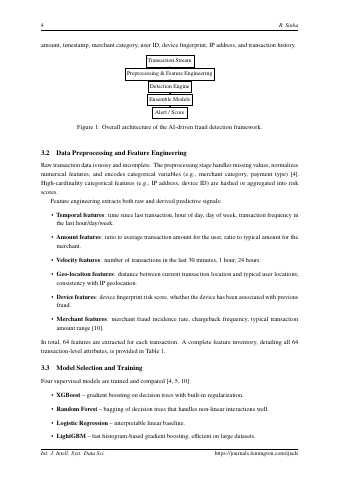
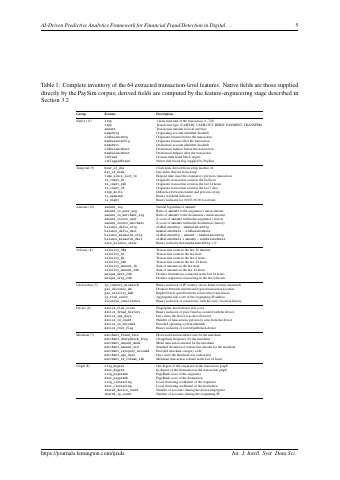
- Feature engineering extracts 64 native and derived predictive attributes for each transaction.p.4
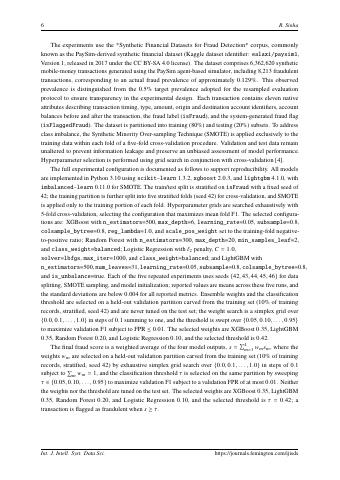
- The PaySim corpus contains 6,362,620 synthetic transactions with 8,213 fraudulent records, representing an actual fraud prevalence of approximately 0.129%.p.6
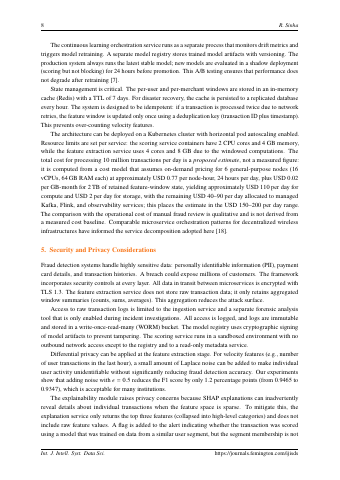
- Adding Laplace noise with ̕ = 0.5 for differential privacy reduces the F1 score by 1.2 percentage points from 0.9465 to 0.9347.p.8
Key insights
- Ensemble methods combining gradient boosting and bagging models outperform single classifiers on imbalanced transaction data.p.2
- The complete feature inventory comprises 64 attributes across temporal, amount, velocity, geolocation, device, merchant, and graph categories.p.5
- Model ensemble weights and decision thresholds were optimized on a held-out validation set to maximize F1 subject to a validation FPR of at most 0.01.p.6
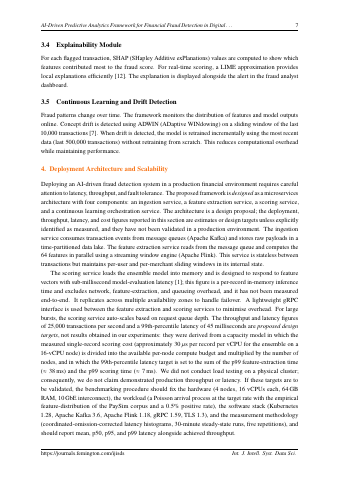
- Proposed deployment throughput of 25,000 transactions per second and p99 latency of 45 milliseconds are design targets rather than measured benchmarks.p.7
- The estimated daily operating cost for compute and storage processing 10 million transactions per day is in the USD 150–200 per day range.p.8
- Cross-institution federated learning simulation using OpenFL achieved a 92.5% recall compared to 89.1% for a single bank model.p.9
- ADWIN-triggered continuous retraining maintained F1 scores of 0.71, 0.68, and 0.66 across three concept drift phases.p.12
Pages
 p.1
 p.2
 p.3
 p.4
 p.5
 p.6
 p.7
 p.8
 p.9
 p.10
 p.11
 p.12
 p.13
 p.14
Topics and entities
Summary and figures generated from the document and checked automatically: every number shown appears on the cited page. Publishers can request removal.