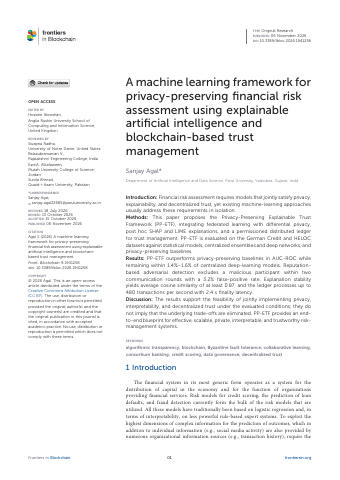
A Machine Learning Framework for Privacy-Preserving Financial Risk Assessment Using Explainable Artificial Intelligence and Blockchain-Based Trust Management (Frontiers in Blockchain)
Summary
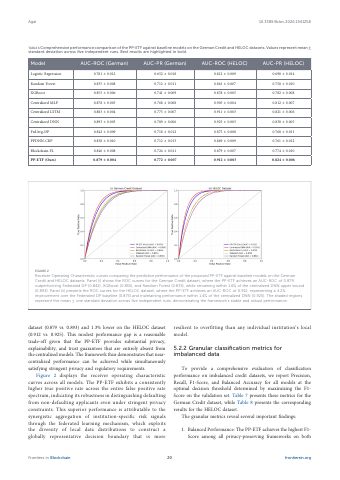
- The Privacy-Preserving Explainable Trust Framework (PP-ETF) achieves AUC-ROC performance within 1.4%–1.6% of centralized deep-learning models while enforcing privacy and decentralized trust guarantees.p.1
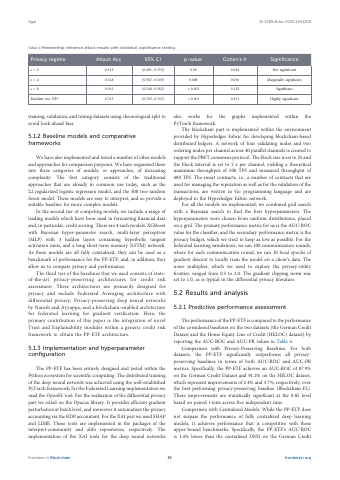
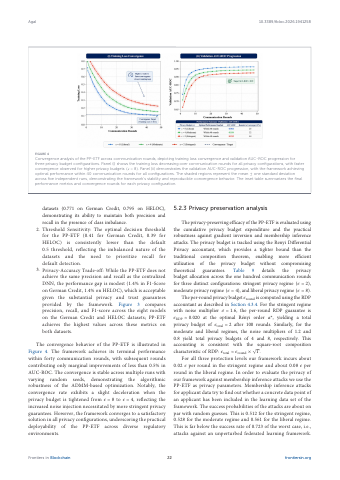
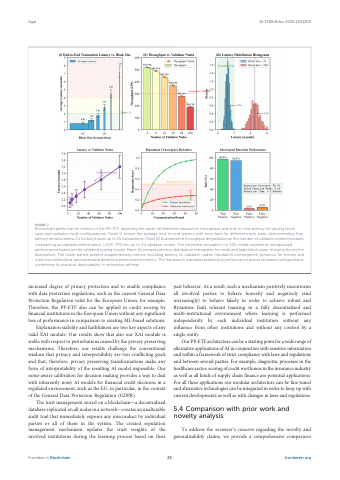
- A reputation-based adversarial detection mechanism excludes malicious participants within two communication rounds with a false-positive rate of 3.2%.p.1
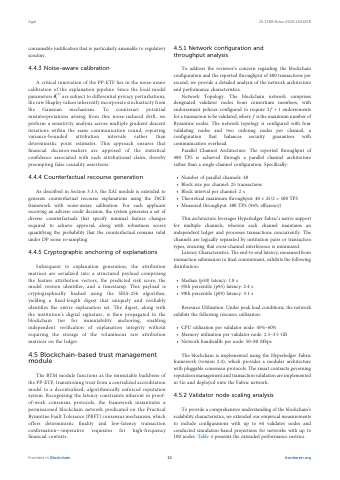
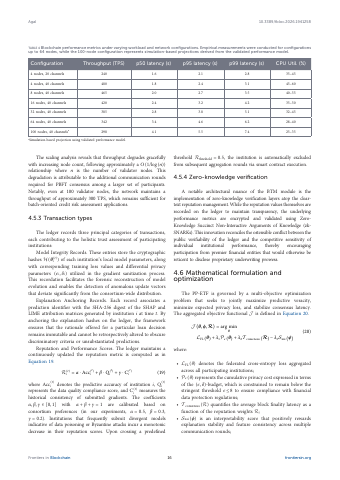
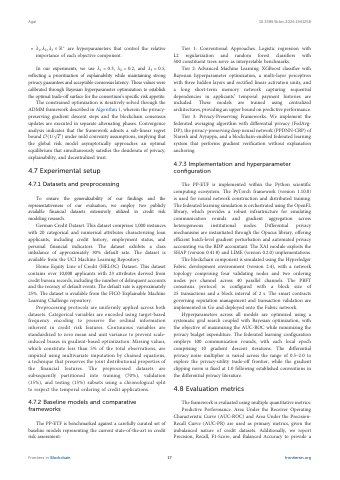
- The underlying permissioned blockchain ledger processes up to 480 transactions per second with a 95th percentile finality latency of 2.4 s across 40 parallel channels.p.15
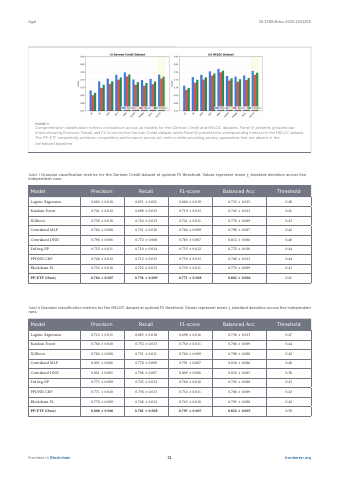
- Explanation completeness reaches 0.94 on the German Credit dataset and 0.96 on the HELOC dataset, compared to 0.81 for models without noise-aware calibration.p.23
Key insights
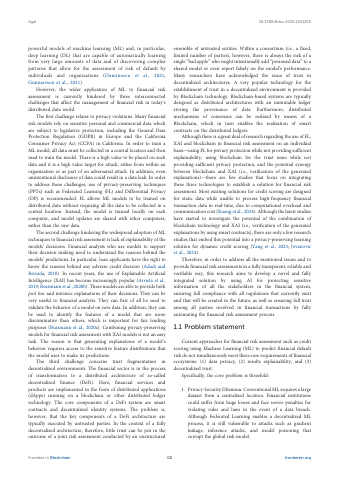
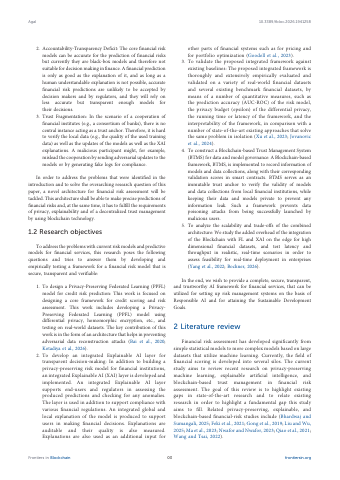
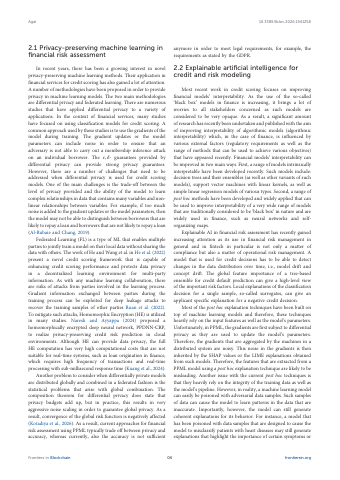
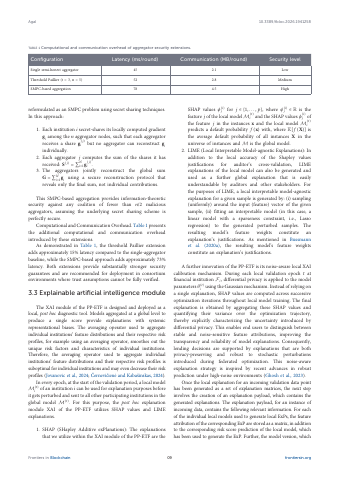
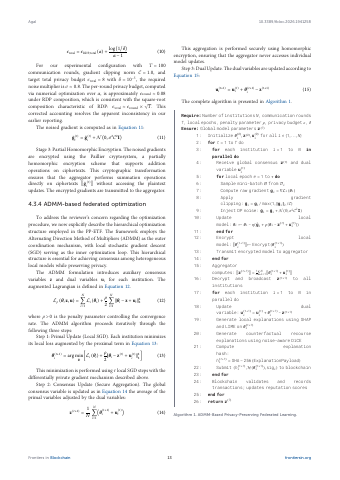
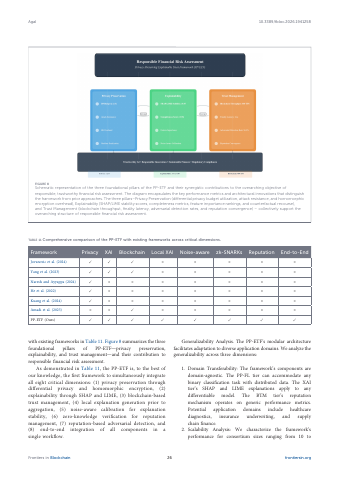
- 1. PP-ETF integrates federated learning, differential privacy, local SHAP and LIME explanations, and permissioned blockchain trust management into a unified financial risk framework.p.1
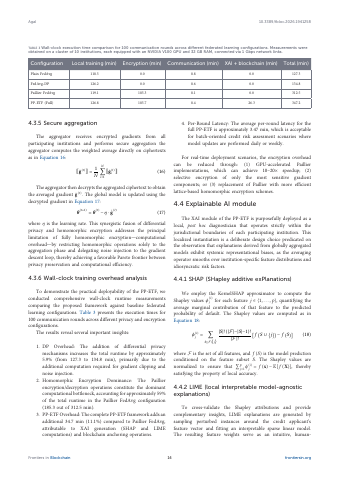
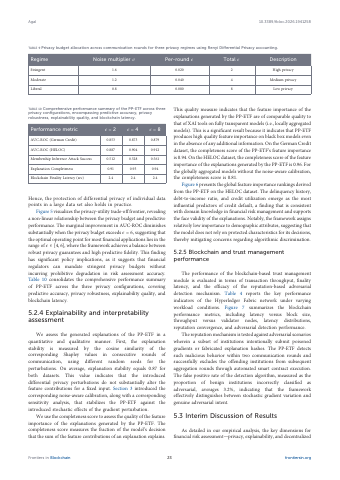
- 2. Differential privacy mechanisms add a modest 5.9% computational runtime overhead to federated averaging, increasing training time from 127.3 min to 134.8 min over 100 rounds.p.14
- 4. High ledger throughput of 480 transactions per second is achieved using a 40-channel parallel architecture operating at 96% efficiency.p.15
- 7. Applying top-k sparsification at k = 1% reduces per-institution gradient communication volume from 512 MB to 5.12 MB per round.p.29
Pages
 p.1
 p.2
 p.3
 p.4
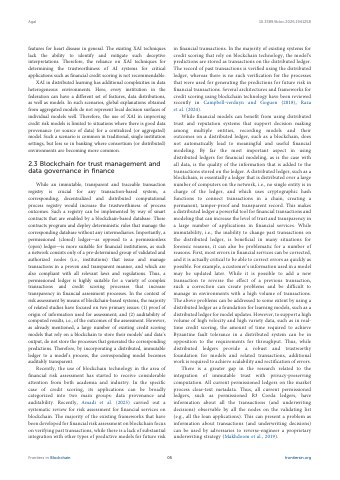 p.5
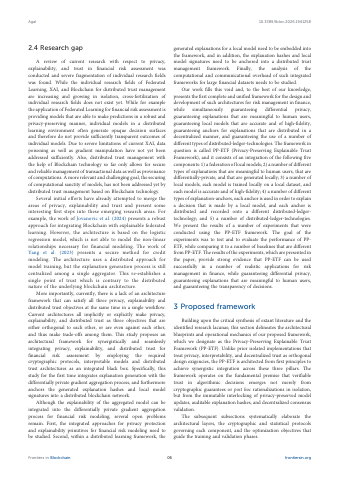 p.6
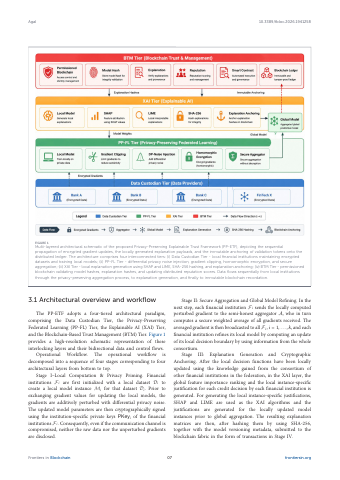 p.7
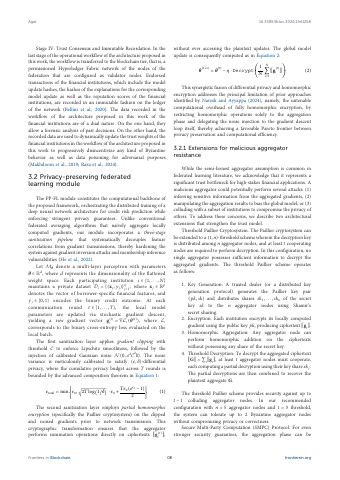 p.8
 p.9
 p.10
 p.11
 p.12
 p.13
 p.14
 p.15
 p.16
 p.17
 p.18
 p.19
 p.20
 p.21
 p.22
 p.23
 p.24
 p.25
 p.26
 p.27
 p.28
 p.29
 p.30
 p.31
 p.32
 p.33
 p.34
Topics and entities
Summary and figures generated from the document and checked automatically: every number shown appears on the cited page. Publishers can request removal.