Zakat Management as a Tool for the Economic Empowerment of the Muslim Community: An Empirical Study of BAZNAS's Role in Improving Community Well-Being (CASHFLOW CURRENT ADVANCED RESEARCH ON SHARIA FINANCE AND ECONOMIC WORLDWIDE)
Summary
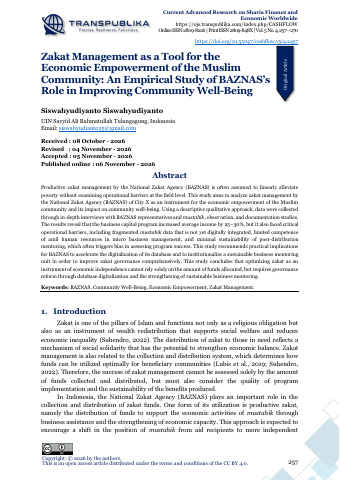
- BAZNAS's business capital assistance program in City X increased average mustahik income by 25–30%.p.1
- Key operational barriers include unintegrated beneficiary data and limited amil competence in micro business management.p.1
- BAZNAS uses regional mapping and criteria based on the eight asnaf categories to determine priority recipients.p.5
- Programs like Zakat Community Development (ZCD) combine entrepreneurship education with business capital distribution.p.5
- Receiving economic empowerment support enables zakat beneficiaries to shift expenditure toward family education and health.p.6
- Community participation in BAZNAS initiatives remains constrained by limited public outreach and awareness.p.8
Key insights
- Productive zakat initiatives drive an average income increase of 25–30% among participating recipients.p.1
- Operational challenges such as fragmented mustahik data and limited amil business expertise restrict program sustainability.p.1
- Targeted distribution relies on regional mapping across high-poverty areas alongside traditional asnaf guidelines.p.5
- Empowerment programs prompt a shift in household spending patterns from basic survival needs to health and education.p.6
- BAZNAS utilizes public reporting and independent external audits to enhance governance transparency and trust.p.7
- Beneficiaries note strong initial program effectiveness but call for continuous post-distribution business mentoring.p.8
- Low public literacy regarding centralized zakat institutions limits overall fund collection and distribution reach.p.8
Pages
 p.1
 p.2
 p.3
 p.4
 p.5
 p.6
 p.7
 p.8
 p.9
 p.10
 p.11
 p.12
 p.13
 p.14
Topics and entities
Summary and figures generated from the document and checked automatically: every number shown appears on the cited page. Publishers can request removal.