The Legal Legitimacy of Cross-Border RWA Financing: Challenges and Responses (Advances in Social Behavior Research)
Summary
- The research analyzes cross-border Real-World Asset (RWA) financing structures originating in Mainland China and issued via a Special Purpose Vehicle (SPV) in Hong Kong.p.1
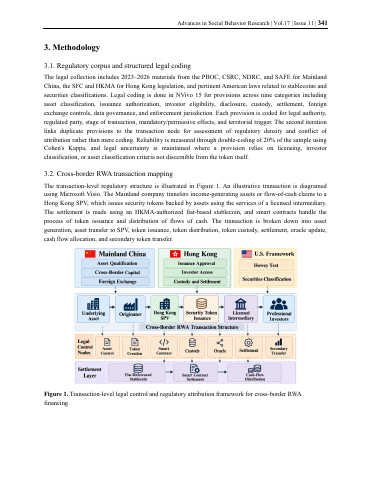
- Structured legal coding evaluated regulatory framework materials from 2023–2026 across 9 distinct categories including custody, asset classification, and foreign exchange controls.p.3
- The study utilized a double-coding sample of 20% to measure coding reliability via Cohen's Kappa.p.3
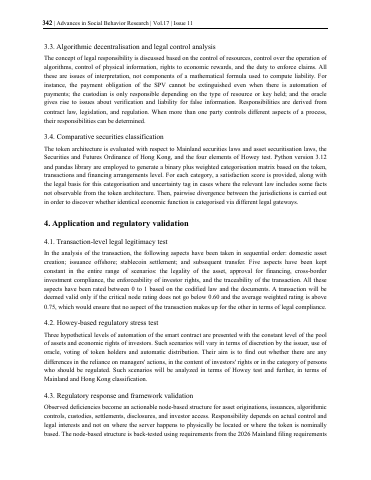
- A transaction legitimacy test establishes that transactions must score at least 0.60 on critical nodes and achieve an average weighted rating above 0.75.p.4
- The framework stress-tested 3 hypothetical levels of smart contract automation to examine dependency on management and regulatory attribution.p.4
Key insights
- Legal legitimacy in cross-border RWA financing requires an enforceable link between on-chain token records and off-chain asset rights across the full lifecycle.p.1
- Functional re-centralisation provides grounds for regulatory attribution whenever an institution retains control over issuance parameters, oracles, or reserve management.p.2
- Cross-border RWA transactions can be structured across distinct stages: asset generation, SPV transfer, issuance, distribution, custody, settlement, oracle updates, and secondary transfer.p.3
- Smart contract automation of payment distributions does not legally discharge or extinguish the payment obligations of an SPV.p.4
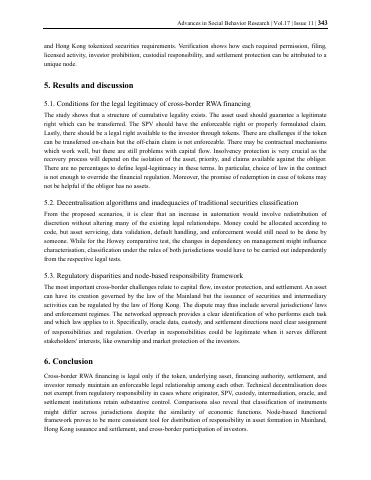
- Contractual choice of law clauses are insufficient to bypass mandatory cross-border financial regulations and capital flow rules.p.5
- Increasing smart contract automation redistributes operational discretion among actors without altering underlying legal and contractual liabilities.p.5
- Technical decentralisation does not grant exemption from regulatory duties when core transaction actors retain substantive economic control.p.6
Pages
 p.1
 p.2
 p.3
 p.4
 p.5
 p.6
Topics and entities
Summary and figures generated from the document and checked automatically: every number shown appears on the cited page. Publishers can request removal.