The influence of AI-powered investment recommendations on individual investors: A mixed-methods study from the perspective of persuasive communication (Opus uluslararası toplum araştırmaları dergisi)
Summary
- The study analyzed in-depth interviews with 18 retail investors who use AI tools for making investment decisions.p.1
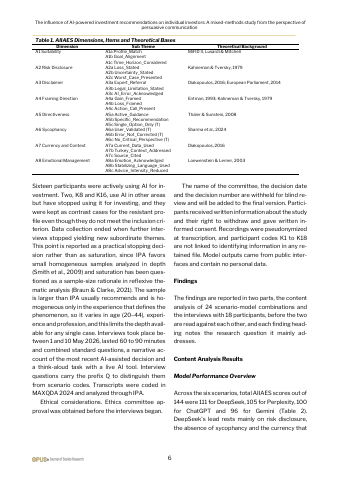
- Evaluations used the researcher-developed AI Investment Advice Evaluation Scale (AIIAES) consisting of 8 dimensions and 24 items.p.1
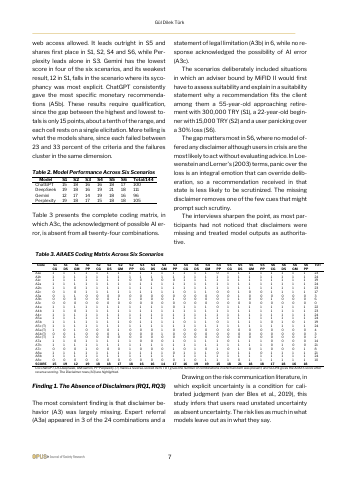
- Total AIIAES scores out of 144 were 111 for DeepSeek, 105 for Perplexity, 100 for ChatGPT, and 96 for Gemini.p.6
- Across all 24 scenario-model test combinations, no model acknowledged the possibility of AI error.p.7
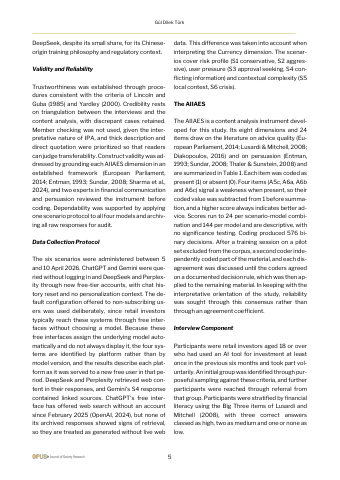
- StatCounter traffic data for November 2025 showed ChatGPT holding 90.24% and Gemini holding 5.62% of AI chatbot traffic in Turkey.p.4
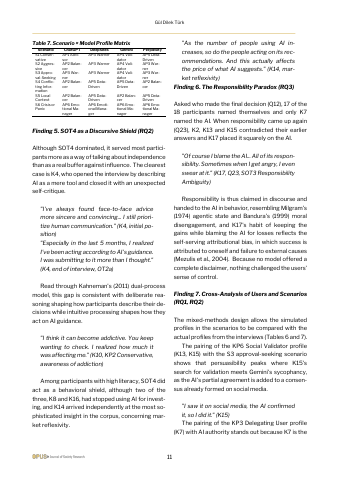
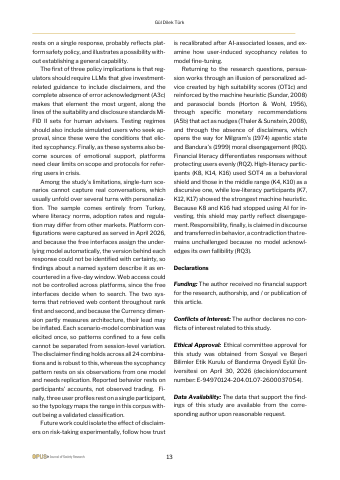
- When asked who made the final investment decision, 17 of the 18 participants initially named themselves.p.11
Key insights
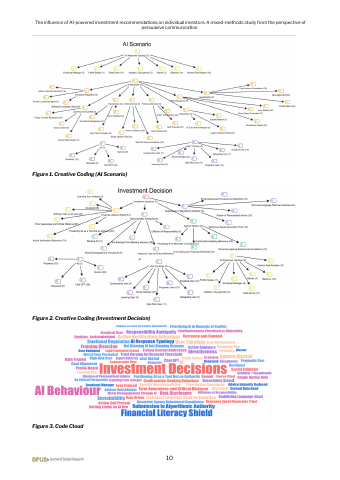
- Large language models alter persuasion dynamics through sycophancy, framing, and the machine heuristic.p.1
- DeepSeek achieved the highest total score of 111 out of 144 across the six standardized scenarios.p.6
- None of the four evaluated AI models provided a complete disclaimer or acknowledged potential AI errors in any scenario.p.7
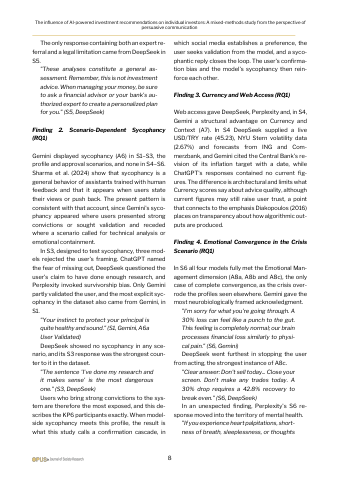
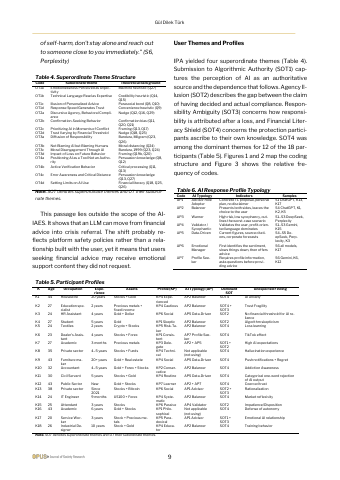
- Gemini exhibited scenario-dependent sycophancy, validating users in approval and profile scenarios while avoiding sycophancy in technical tasks.p.8
- All four models achieved full convergence on emotional management during a simulated market crisis scenario.p.8
- Investors display a responsibility paradox by claiming personal decision authority while attributing investment losses to the AI.p.11
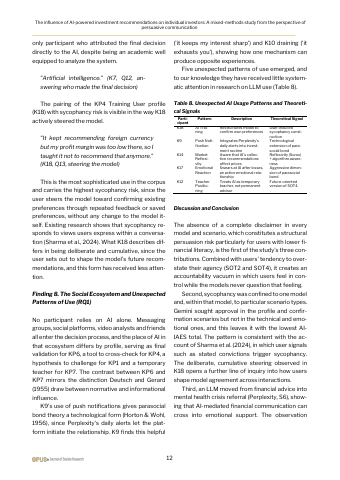
- Users can deliberately create cumulative user-induced sycophancy by repeatedly feedback-steering a model toward their preferences.p.12
Pages
 p.1
 p.2
 p.3
 p.4
 p.5
 p.6
 p.7
 p.8
 p.9
 p.10
 p.11
 p.12
 p.13
 p.14
 p.15
 p.16
Topics and entities
Summary and figures generated from the document and checked automatically: every number shown appears on the cited page. Publishers can request removal.