The Architecture of AI Governance in Banking: Bridging Compliance and Explainability Gaps (Pacific Journal of Advanced Engineering Innovations)
Summary
- AI governance integrates explainability, model risk management, lifecycle governance, and internal controls to satisfy regulatory expectations in banking.p.1
- Regulatory guidance such as SR 11 7 highlights the necessity of lifecycle-based model risk management covering development, validation, deployment, and continuous monitoring.p.2
- Governance explainability requires banks to document approval rationales, testing methodology, assumptions, and performance metrics throughout the model lifecycle.p.2
- Implementation patterns in banking prioritize high-stakes use cases like credit decisioning due to direct consumer and regulatory impacts.p.4
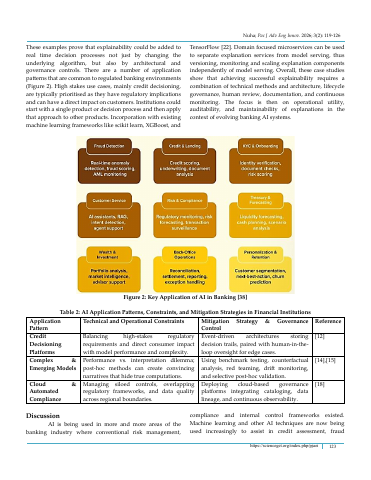
- Technical integration often relies on standard machine learning frameworks such as scikit learn, XGBoost, and TensorFlow combined with microservice architectures.p.5
- Evaluating third-party AI requires evaluating vendor model performance, limitations, data integrity, update mechanisms, and contractual accountability.p.6
Key insights
- AI explainability operates as an architectural and governance capability rather than a technical feature appended at the end of model development.p.1
- SR 11 7 provides a pivotal model risk management reference requiring conceptual soundness, implementation accuracy, and output reasonableness.p.2
- High-stakes applications such as credit scoring are prioritized for explainability structures because of their regulatory oversight and consumer impacts.p.4
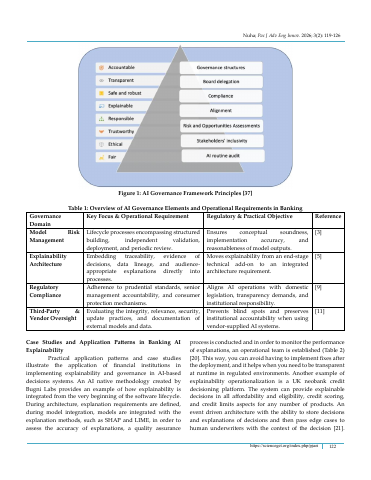
- Bugni Labs established an AI-native approach that incorporates SHAP and LIME explanation tools during the model integration software phase.p.4
- Event-driven architectures allow UK neobank platforms to preserve decision trails and escalate complex edge cases to human underwriters.p.4
- Domain-focused microservices isolate explanation tools from primary model serving, facilitating independent scaling and version control.p.5
- Relying solely on post-hoc explanation methods presents risks as plausible explanations may not reflect true underlying computational processes.p.6
Pages
 p.1
 p.2
 p.3
 p.4
 p.5
 p.6
 p.7
 p.8
Topics and entities
Summary and figures generated from the document and checked automatically: every number shown appears on the cited page. Publishers can request removal.