Temporal Layering and Rule-Based Matching in Distributed Settlement Ledgers: A Multi-Horizon Reconciliation Architecture for Financial Break Detection (International Journal of Intelligent Systems and Data Science)
Summary
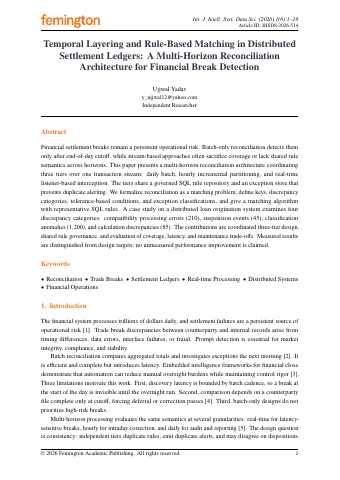
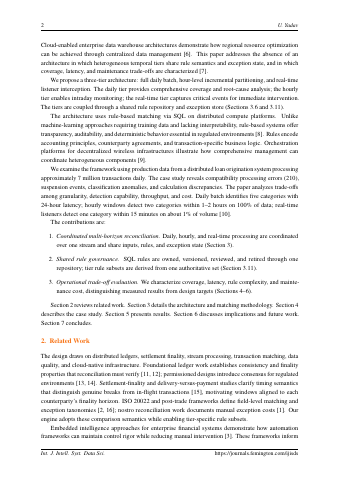
- The paper introduces a multi-horizon reconciliation architecture that coordinates daily batch, hourly incremental partitioning, and real-time listener interception over a single transaction stream.p.1
- The empirical study evaluated one month of production data totaling 210 million transactions from a distributed loan origination system processing approximately 7 million transactions daily.p.9
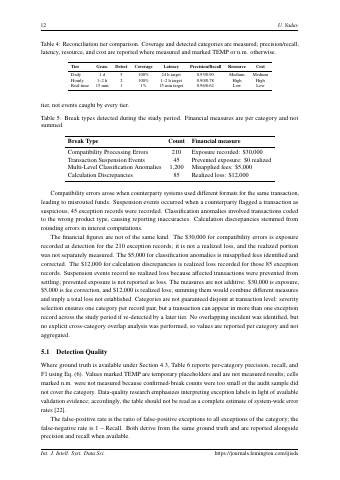
- The evaluation identified 1,200 classification anomaly exception records, representing $5,000 in misapplied fees.p.12
- Operational testing detected 210 compatibility processing error exception records, representing $30,000 in exposure recorded at detection.p.12
- The platform recorded 85 calculation discrepancy exception records, resulting in $12,000 of realized loss.p.12
Key insights
- A shared rule repository and unified exception store prevent duplicate alerting and maintain semantic consistency across distinct temporal tiers.p.1
- Deterministic rule-based SQL logic provides the auditability and interpretability essential for regulated financial reconciliation compared to machine-learning models.p.2
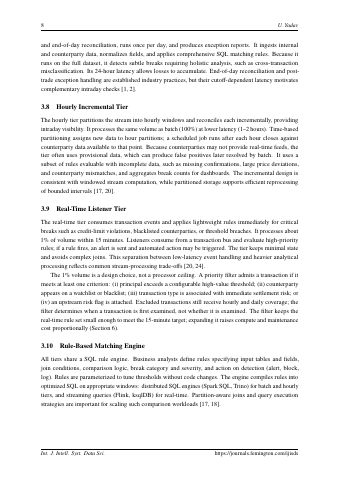
- The real-time listener tier evaluates approximately 1% of transaction volume filtered by risk criteria within a 15-minute latency target.p.8
- Transaction suspension events generated 45 exception records with $0 realized loss because settlement was blocked prior to execution.p.12
Pages
 p.1
 p.2
 p.3
 p.4
 p.5
 p.6
 p.7
 p.8
 p.9
 p.10
 p.11
 p.12
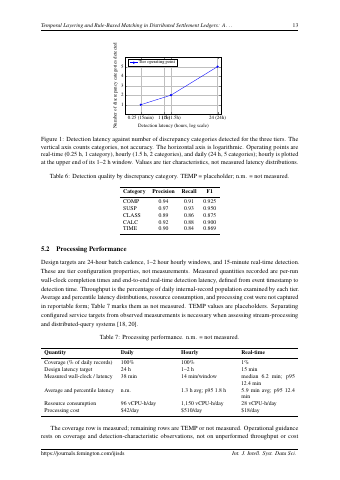 p.13
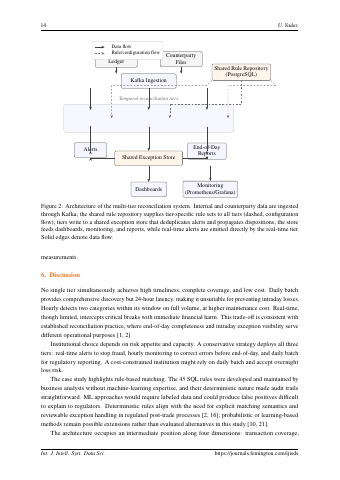 p.14
 p.15
 p.16
 p.17
 p.18
Topics and entities
Summary and figures generated from the document and checked automatically: every number shown appears on the cited page. Publishers can request removal.