Powering Development? Chinese Energy Investment, Artificial Intelligence, and Local Electrification in Africa (Applied and Computational Engineering)
Summary
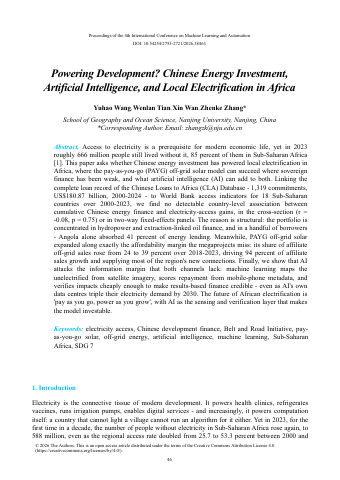
- In 2023, roughly 666 million people lived without access to electricity, with 85 percent of them located in Sub-Saharan Africa.p.1
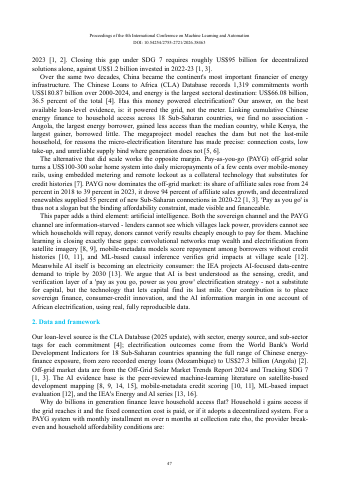
- The Chinese Loans to Africa (CLA) Database registered 1,319 commitments worth US$180.87 billion between 2000 and 2024, with energy as the largest sector at US$66.08 billion (36.5 percent).p.2
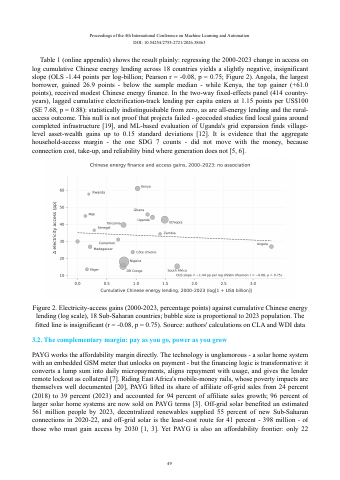
- Cross-country empirical analysis of 18 Sub-Saharan nations reveals no statistically significant correlation between cumulative Chinese energy loans and national electricity access gains (r = -0.08, p = 0.75).p.1
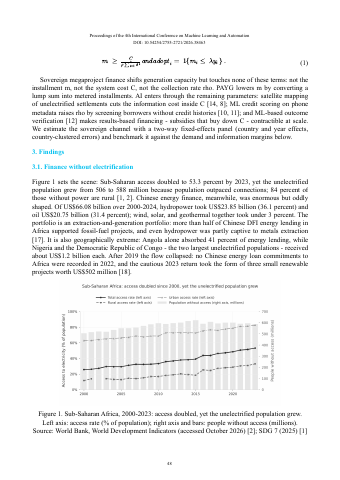
- Chinese energy lending was heavily concentrated, with Angola absorbing 41 percent of total energy loans, while hydropower (US$23.85 billion) and oil (US$20.75 billion) dominated the portfolio.p.3
- Pay-as-you-go (PAYG) off-grid solar increased its affiliate sales share from 24 percent in 2018 to 39 percent in 2023, generating 94 percent of affiliate sales growth.p.4
- Achieving SDG 7 decentralized power targets requires an estimated US$95 billion, compared to just US$1.2 billion invested in 2022-23.p.2
Key insights
- Aggregate household electricity access gains across Sub-Saharan Africa show no detectable statistical association with total cumulative Chinese energy lending.p.1
- More than half of Chinese DFI energy funding in Africa supported fossil-fuel extraction and generation rather than distributed local end-user connections.p.3
- Angola absorbed 41 percent of Chinese energy loans but achieved access gains below the sample median, whereas Kenya borrowed modestly and gained +61.0 points in access rate.p.4
- Off-grid solar represents the lowest-cost path to electrification for 41 percent—or 398 million—of the people needing power access by 2030.p.4
- Severe affordability barriers persist as only 22 percent of unelectrified households can afford a Tier 1 solar home system at current market prices.p.4
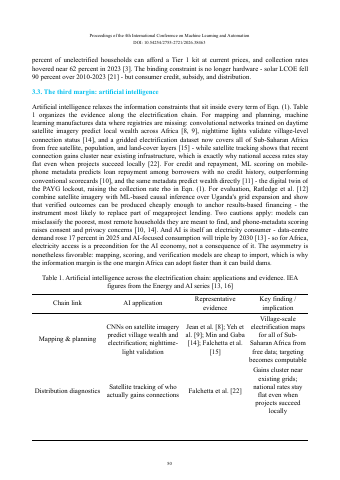
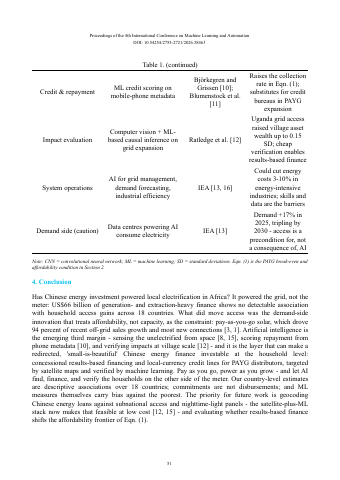
- Machine learning addresses critical information deficits by identifying unelectrified settlements via satellite images and predicting loan repayment through mobile-phone metadata.p.2
- Artificial intelligence data centres increased their global electricity consumption by 17 percent in 2025 and are projected to triple demand by 2030.p.5
Pages
 p.1
 p.2
 p.3
 p.4
 p.5
 p.6
 p.7
Topics and entities
Summary and figures generated from the document and checked automatically: every number shown appears on the cited page. Publishers can request removal.