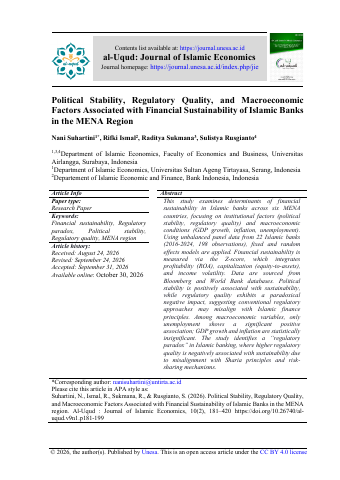
Political Stability, Regulatory Quality, and Macroeconomic Factors Associated with Financial Sustainability of Islamic Banks in the MENA Region (al-Uqud Journal of Islamic Economics)
Summary
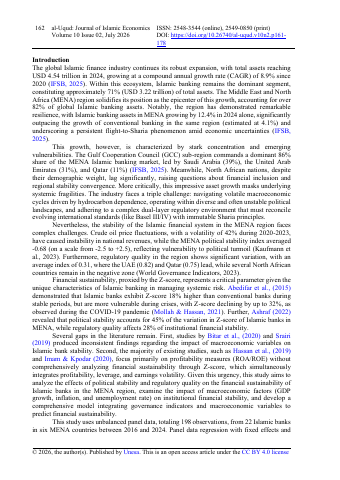
- Global Islamic finance total assets reached USD 4.54 trillion in 2024, expanding at a compound annual growth rate of 8.9% since 2020.p.2
- Islamic banking represents 71% (USD 3.22 trillion) of global Islamic finance assets, with the MENA region accounting for over 82% of global Islamic banking assets.p.2
- The GCC sub-region holds an 86% share of the MENA Islamic banking market, led by Saudi Arabia at 39%, the United Arab Emirates at 31%, and Qatar at 11%.p.2
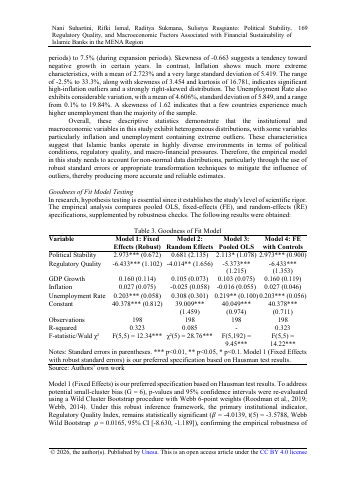
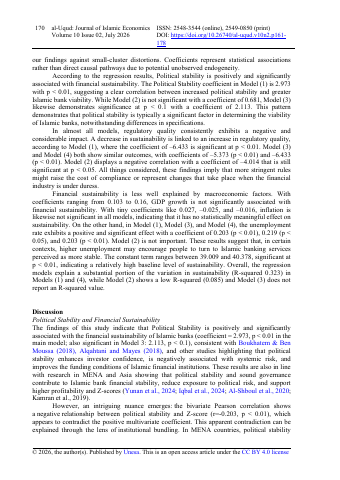
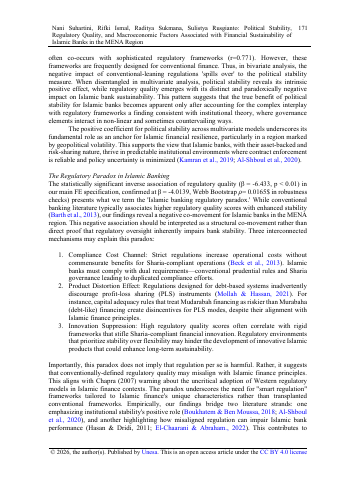
- In the main fixed effects regression model, regulatory quality exhibits a negative association with financial sustainability, with a coefficient of -6.433.p.9
- Political stability shows a positive association with Islamic bank financial sustainability, with a regression coefficient of 2.973.p.9
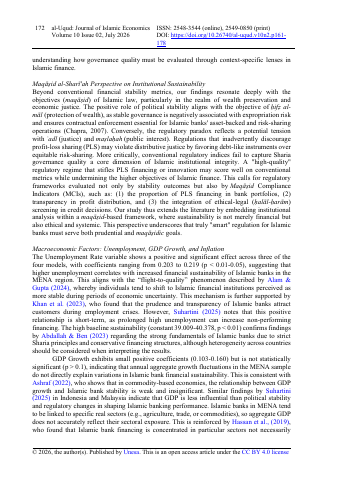
- The unemployment rate demonstrates a positive association with financial sustainability in the fixed effects model, yielding a coefficient of 0.203.p.9
Key insights
- Political stability is positively associated with the financial sustainability of Islamic banks in the MENA region.p.1
- Higher regulatory quality exhibits a paradoxical negative association with Islamic bank financial sustainability due to misalignment with Sharia principles.p.1
- Islamic banking assets in the MENA region grew by 12.4% in 2024 alone, outperforming conventional banking asset growth estimated at 4.1%.p.2
- Annual GDP growth showed no statistically significant association with financial sustainability in the primary fixed effects specification.p.9
- Inflation rate variations were statistically insignificant across all tested regression models.p.9
- The unemployment rate exhibited a statistically significant positive coefficient of 0.203 in the fixed effects specification.p.9
Pages
 p.1
 p.2
 p.3
 p.4
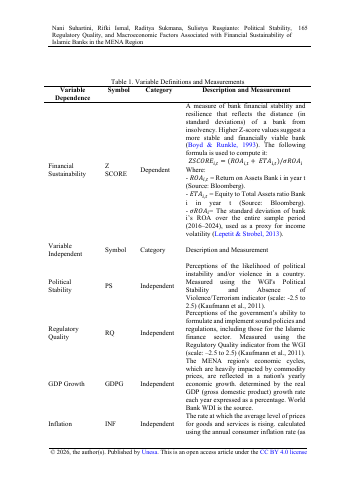 p.5
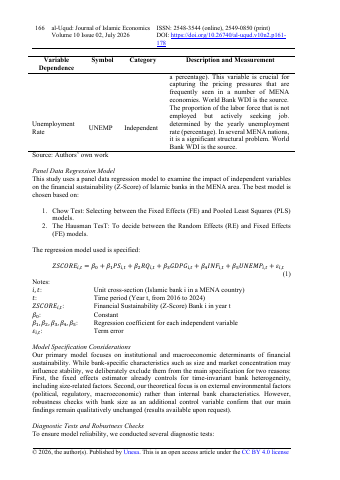 p.6
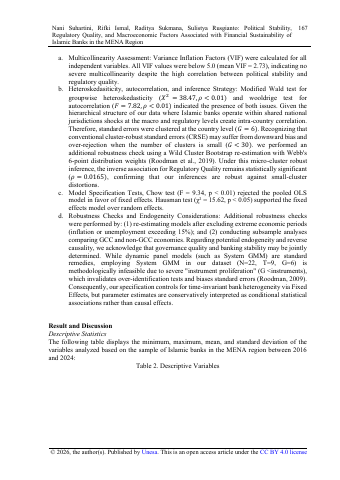 p.7
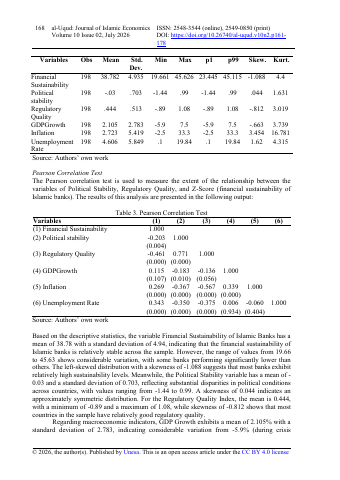 p.8
 p.9
 p.10
 p.11
 p.12
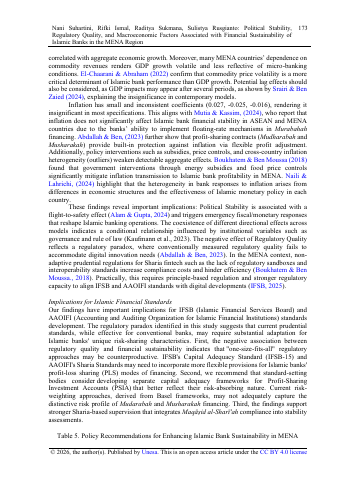 p.13
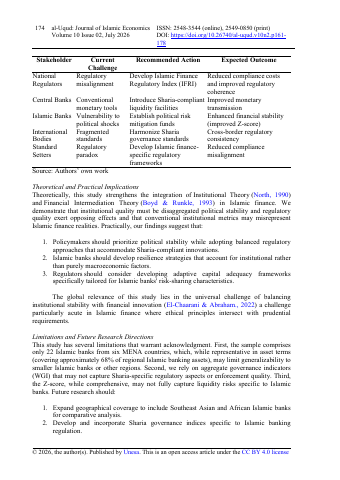 p.14
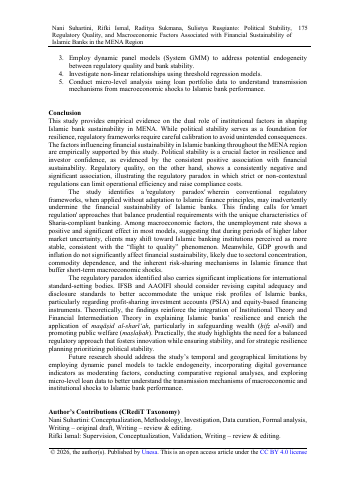 p.15
 p.16
 p.17
 p.18
Topics and entities
Summary and figures generated from the document and checked automatically: every number shown appears on the cited page. Publishers can request removal.