Measuring Ethereum's Energy Consumption for EU Reporting (Zenodo (CERN European Organization for Nuclear Research))
Summary
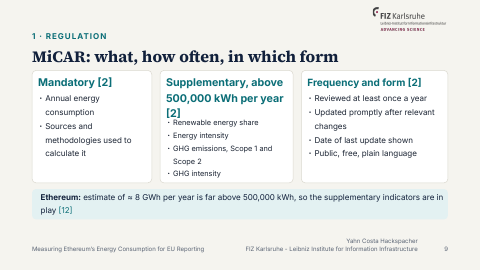
- Under the EU Markets in Crypto-Assets Regulation (MiCAR), supplementary sustainability reporting is triggered when annual energy consumption exceeds 500,000 kWh per year.p.9
- Ethereum's total network energy consumption is estimated at approximately 8 GWh per year, requiring full supplementary indicator reporting under MiCAR.p.9
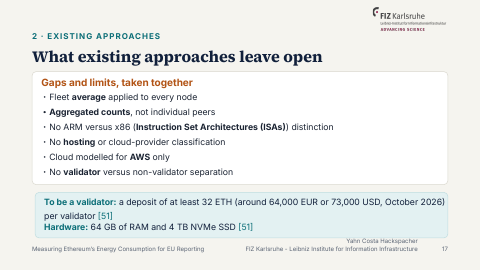
- Solo staking as an Ethereum validator requires a deposit of at least 32 ETH, equivalent to around 64,000 EUR or 73,000 USD in October 2026.p.17
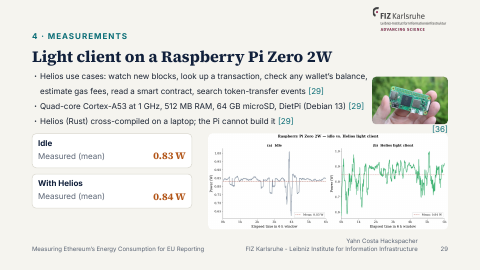
- Running the Helios light client on a Raspberry Pi Zero 2W consumes a measured mean power of 0.84 W compared to an idle draw of 0.83 W.p.29
Key insights
- MiCAR mandates annual reporting on energy consumption, renewable energy share, greenhouse gas emissions, and energy intensity for crypto-asset providers.p.9
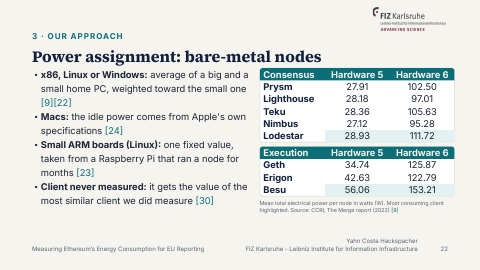
- Existing energy models often apply fleet averages without distinguishing between ARM and x86 architectures or separating validator nodes from non-validators.p.17
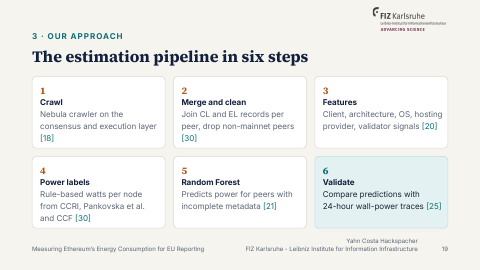
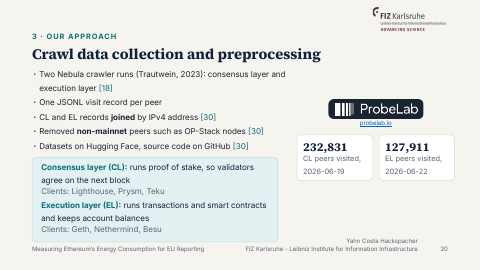
- The estimation pipeline joins consensus layer and execution layer peer records using IPv4 address matching while filtering out non-mainnet peers.p.20
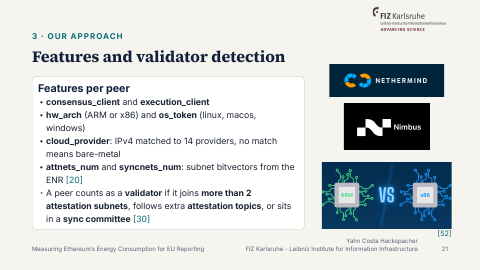
- Nodes are classified as validators if they participate in more than 2 attestation subnets, follow extra attestation topics, or belong to a sync committee.p.21
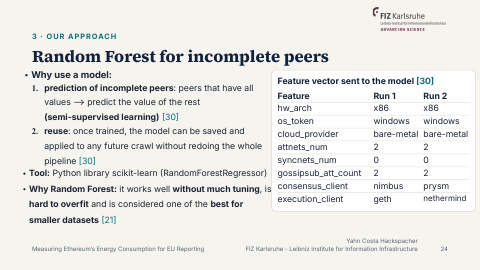
- A Random Forest regression model is used to predict power consumption values for peers with incomplete metadata.p.24
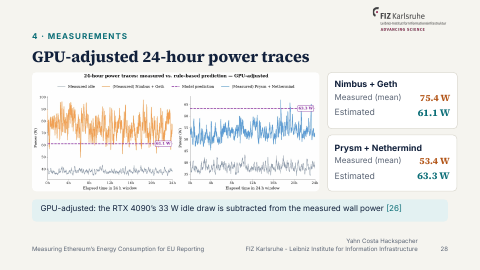
- Measured wall power for Prysm + Nethermind yielded a GPU-adjusted mean of 53.4 W against a model estimate of 63.3 W.p.28
- The Helios light client enables basic blockchain state queries while drawing only 0.84 W on low-power hardware like a Raspberry Pi Zero 2W.p.29
Pages
 p.1
 p.2
 p.3
 p.4
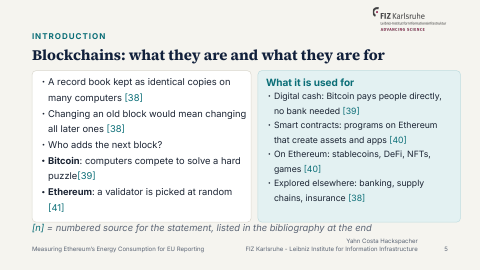 p.5
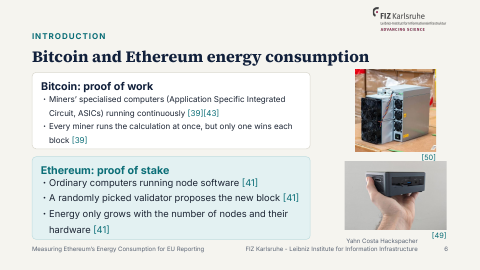 p.6
 p.7
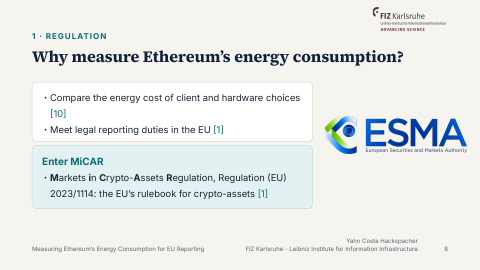 p.8
 p.9
 p.10
 p.11
 p.12
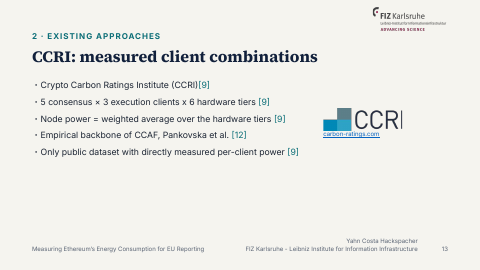 p.13
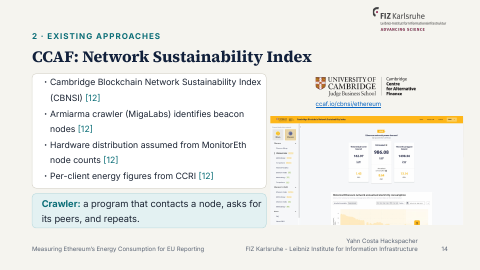 p.14
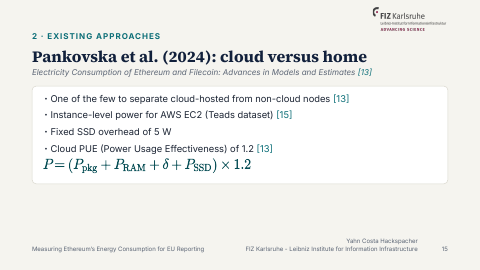 p.15
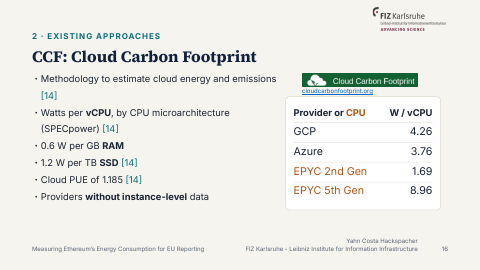 p.16
 p.17
 p.18
 p.19
 p.20
 p.21
 p.22
 p.23
 p.24
 p.25
 p.26
 p.27
 p.28
 p.29
 p.30
 p.31
 p.32
 p.33
 p.34
 p.35
 p.36
 p.37
 p.38
Topics and entities
Summary and figures generated from the document and checked automatically: every number shown appears on the cited page. Publishers can request removal.