Integrating Islamic Financial and Audit Governance for Strengthening Merah Putih Cooperatives in Indonesia (REFERENSI ISLAMIKA Jurnal Studi Islam)
Summary
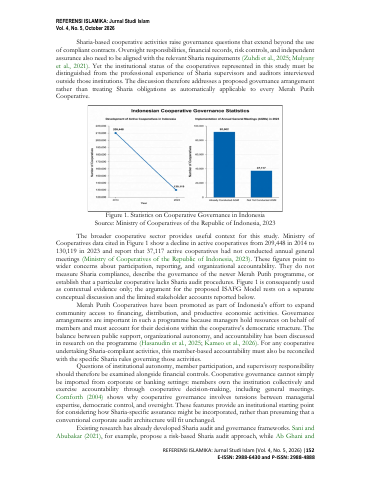
- Data from the Ministry of Cooperatives shows that the number of active cooperatives in Indonesia declined from 209,448 in 2014 to 130,119 in 2023.p.2
- The Ministry of Cooperatives 2023 dataset reveals that 37,117 active cooperatives had not conducted annual general meetings.p.2
- The qualitative research design evaluated governance perspectives across 6 purposively selected participants from management, Sharia supervision, audit, academia, and regulation.p.3
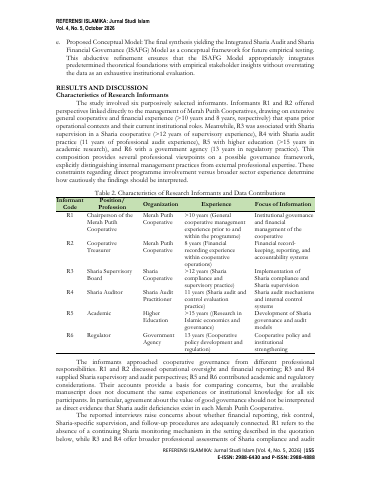
- Informants brought extensive background experience, including R1 with >10 years in management and R5 with >15 years in academic research.p.5
- The audit practitioner informant R4 contributed 11 years of professional experience in Sharia audit and internal control evaluation.p.5
- Regulatory considerations were drawn from informant R6, who possessed 13 years of experience in cooperative policy development.p.5
Key insights
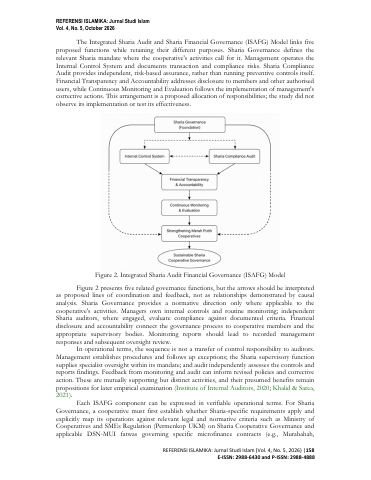
- The study synthesizes five core governance functions into the Integrated Sharia Audit and Sharia Financial Governance (ISAFG) Model to align oversight and financial controls.p.1
- National data from 2023 highlights structural operational challenges, noting thousands of active cooperatives that failed to execute required annual general meetings.p.2
- Cooperative governance structures cannot be directly copied from commercial banking environments because member ownership requires democratic oversight through general meetings.p.2
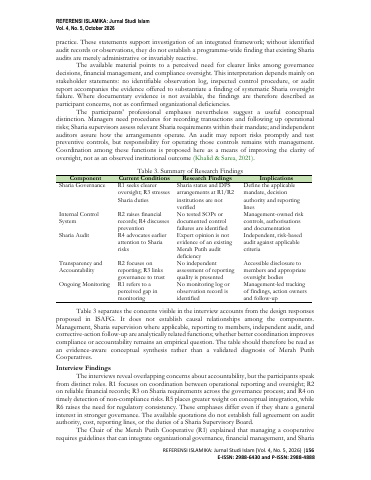
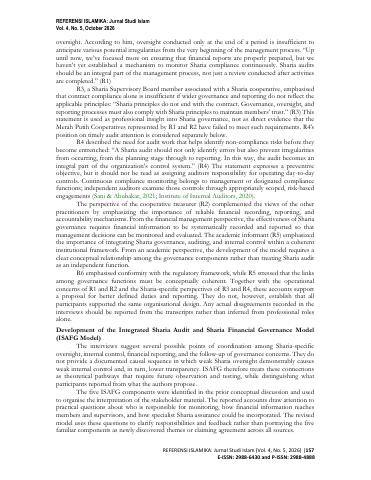
- Everyday operational risk controls and continuous monitoring remain the responsibility of management rather than independent Sharia auditors.p.6
- Financial reporting in Sharia-compliant cooperatives should adhere to Indonesian Financial Accounting Standards for Sharia Entities, specifically PSAK 101/SAS.p.9
- Implementation of the ISAFG model in rural settings faces bottlenecks due to limited human resources and a shortage of staff skilled in both accounting and Sharia audit.p.12
Pages
 p.1
 p.2
 p.3
 p.4
 p.5
 p.6
 p.7
 p.8
 p.9
 p.10
 p.11
 p.12
 p.13
 p.14
 p.15
Topics and entities
Summary and figures generated from the document and checked automatically: every number shown appears on the cited page. Publishers can request removal.