Integrating Artificial Intelligence into Islamic Finance: Opportunities and Challenges (International Journal of Islamic Business)
Summary
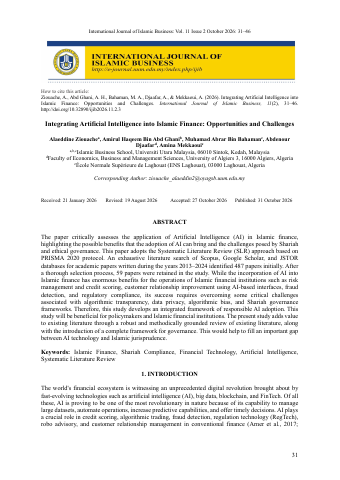
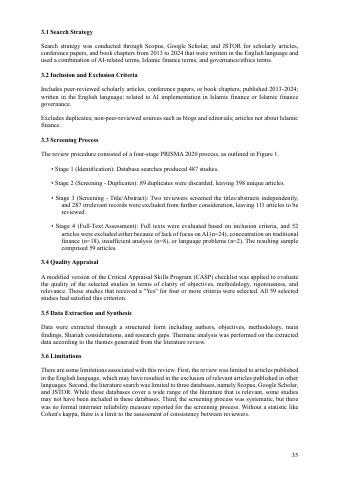
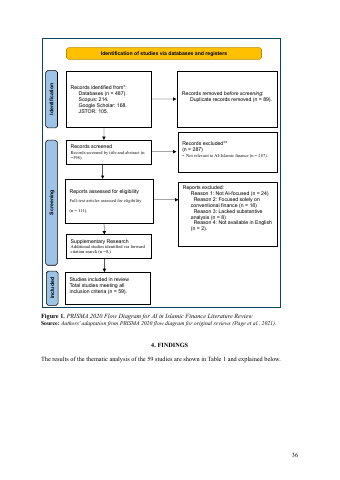
- An initial search across Scopus, Google Scholar, and JSTOR databases spanning 2013 to 2024 yielded 487 academic papers on AI in Islamic finance.p.1
- Following a systematic screening protocol based on PRISMA 2020 guidelines, 59 papers were retained for full analysis.p.1
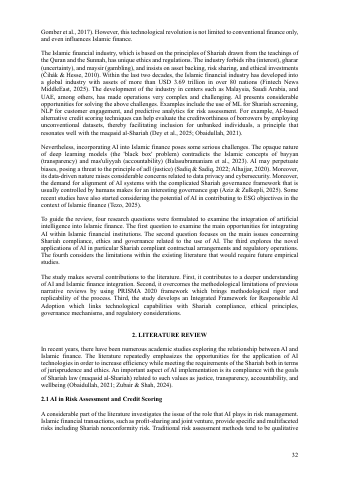
- The global Islamic financial industry has grown into a major sector with assets exceeding USD 3.69 trillion across more than 80 countries.p.2
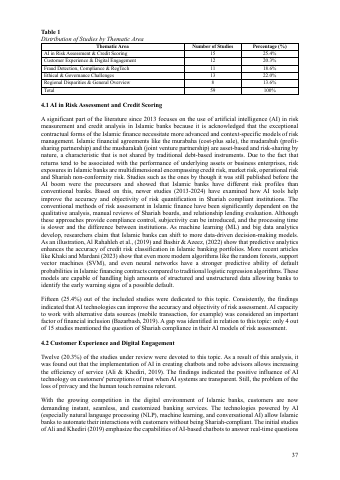
- AI in Risk Assessment & Credit Scoring represented the largest thematic group of reviewed papers, accounting for 15 studies or 25.4% of the total.p.7
Key insights
- Integrating artificial intelligence into Islamic finance offers operational efficiency in credit scoring, customer engagement, fraud detection, and regulatory compliance.p.1
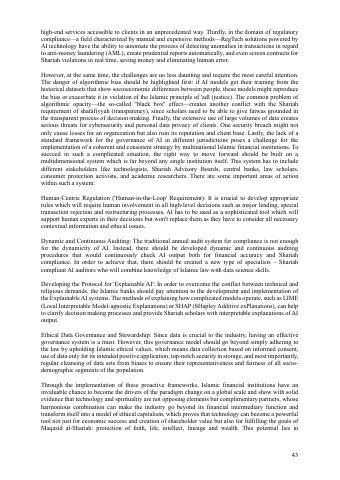
- The opaque nature of deep learning black box models directly conflicts with Islamic concepts of transparency (bayyan) and accountability (mas'uliyyah).p.2
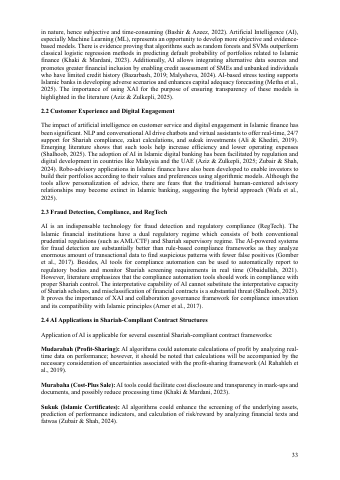
- Machine learning algorithms such as random forests and support vector machines demonstrate superior predictive capabilities for Islamic finance default risks compared to standard logistic regression.p.3
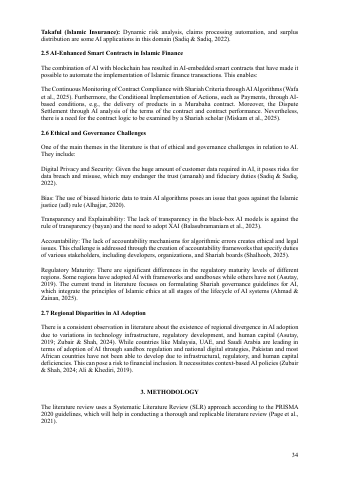
- Embedding artificial intelligence within blockchain smart contracts allows automated and continuous real-time monitoring of transactions against Shariah standards.p.4
- Out of 15 analyzed studies on AI risk assessment, only 4 explicitly addressed Shariah compliance within their credit scoring models.p.7
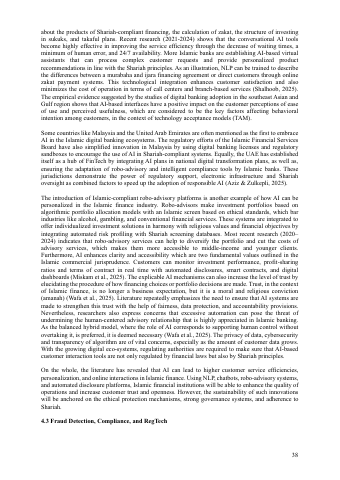
- Conversational AI and natural language processing facilitate 24/7 client support for specialized Islamic finance tasks such as zakat calculations and sukuk investments.p.8
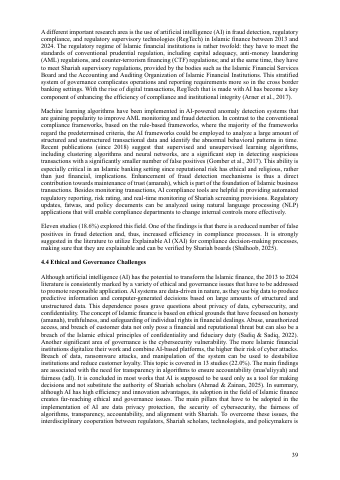
- AI-driven RegTech solutions enhance anti-money laundering controls by identifying anomalous behavior with fewer false positives than standard rule-based frameworks.p.9
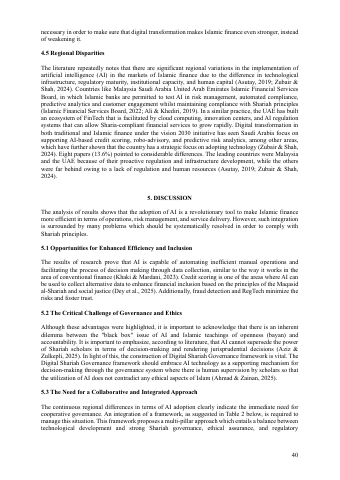
- Substantial regional disparities exist in AI adoption, with Malaysia and the UAE leading due to proactive regulatory sandboxes and infrastructure investments.p.10
Pages
 p.1
 p.2
 p.3
 p.4
 p.5
 p.6
 p.7
 p.8
 p.9
 p.10
 p.11
 p.12
 p.13
 p.14
 p.15
 p.16
Topics and entities
Summary and figures generated from the document and checked automatically: every number shown appears on the cited page. Publishers can request removal.