Financial Literacy and Tax Management Among Market Traders in Northern Peru: The Moderating Role of Business Formalisation (F1000Research)
Summary
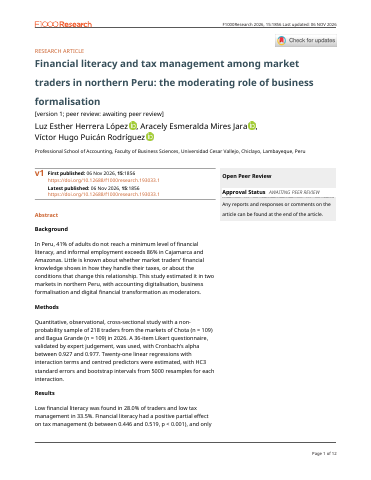
- A study of 218 market traders in Chota and Bagua Grande revealed that 28.0% had low financial literacy and 33.5% had low tax management.p.1
- Financial literacy showed a positive partial effect on tax management with coefficients between 0.446 and 0.519 across all evaluated moderators.p.1
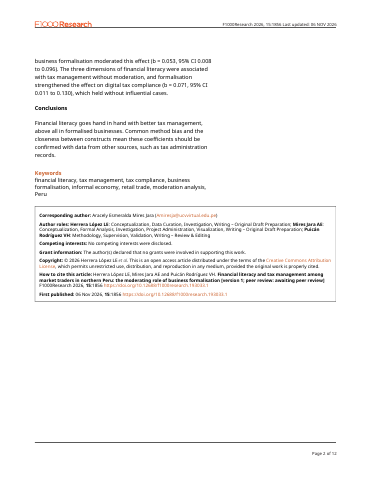
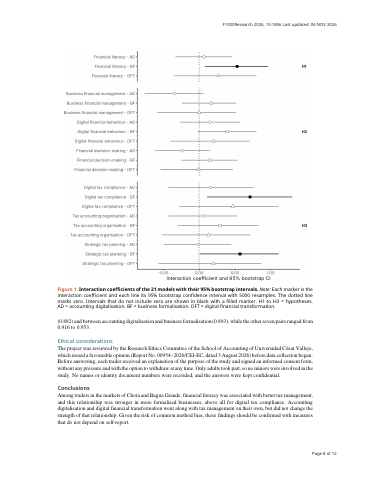
- Business formalisation significantly moderated the effect of financial literacy on tax management (b = 0.053, 95% CI 0.008 to 0.096).p.2
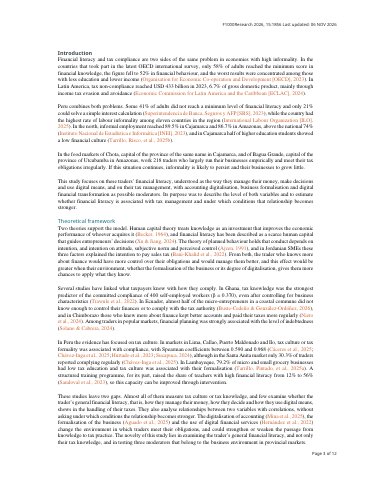
- In Peru, 41% of adults did not reach a minimum level of financial literacy, and informal employment reached 89.5% in Cajamarca and 86.7% in Amazonas.p.3
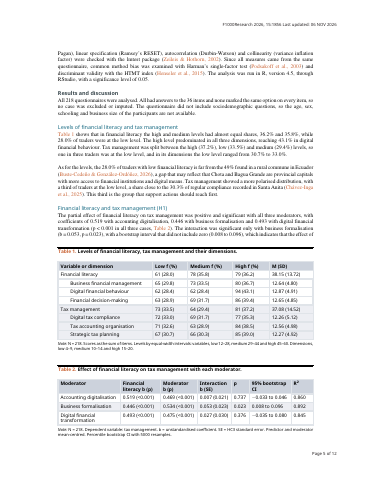
- High levels predominated across financial literacy dimensions, reaching 43.1% in digital financial behaviour.p.5
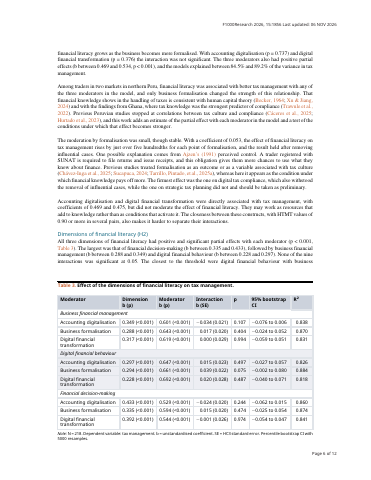
- Among financial literacy dimensions, financial decision-making had the largest partial effect on tax management, with coefficients between 0.335 and 0.433.p.6
Key insights
- Low financial literacy was identified in 28.0% of market traders, while 33.5% exhibited low tax management.p.1
- Financial literacy maintained a significant positive partial effect on tax management across all three moderating models (p < 0.001).p.5
- Business formalisation was the only moderator that significantly altered the effect of financial literacy on tax management (b = 0.053, p = 0.023).p.5
- Financial decision-making demonstrated the highest partial effect on tax management among financial literacy dimensions (b between 0.335 and 0.433).p.6
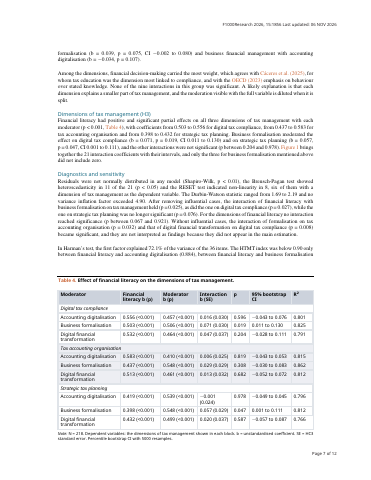
- Business formalisation significantly moderated the effect of financial literacy on digital tax compliance (b = 0.071, p = 0.019).p.7
- Harman's single-factor test indicated that the first factor accounted for 72.1% of the total variance across the 36 items.p.7
Pages
 p.1
 p.2
 p.3
 p.4
 p.5
 p.6
 p.7
 p.8
 p.9
 p.10
 p.11
 p.12
Topics and entities
Summary and figures generated from the document and checked automatically: every number shown appears on the cited page. Publishers can request removal.