Entrepreneurial Orientation and Strategic Agility in VUCA Africa: Developing an Ambidextrous Strategic Emergence Model for FinTech Organisations (International Journal of Business Ecosystem and Strategy (2687-2293))
Summary
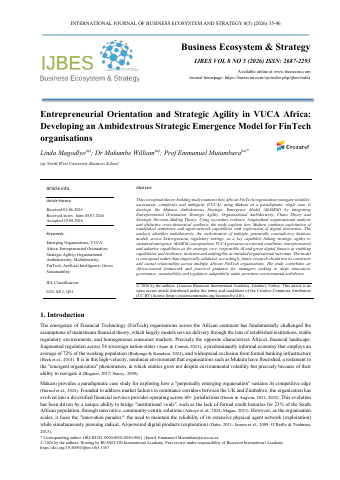
- Africa's financial landscape is defined by fragmented regulation across 54 sovereign nation-states and an informal economy employing 72% of the working population on average.p.1
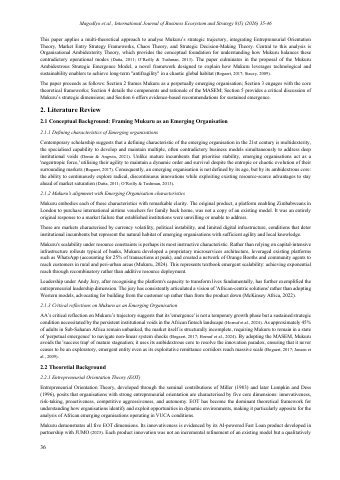
- Mukuru achieved emergent scalability using microservices, community agents, and existing platforms like WhatsApp, which accounted for 25% of transactions at peak.p.2
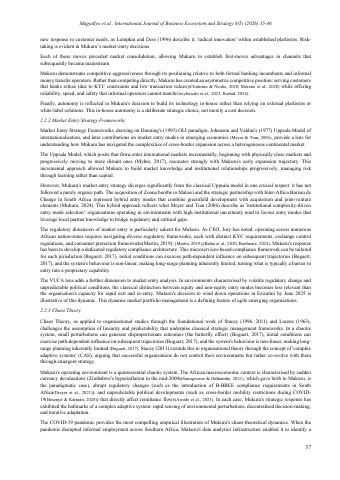
- Managing volatile regulatory shifts requires dynamic portfolio management, such as Mukuru's decision to wind down operations in Eswatini by June 2025.p.3
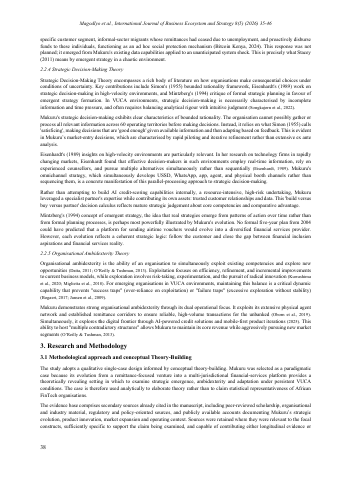
- Operating across 60 operating territories, Mukuru employs parallel-processing strategies across app, WhatsApp, agent, and physical booth channels.p.4
- Alternative AI credit scoring allows Mukuru to expand financial services to the 23% of South Africans systematically excluded from formal banking.p.6
- Formalising green digital finance and paperless operations helps FinTechs target the $600 billion ESG-focused bond market.p.10
Key insights
- Emerging FinTech organisations thrive in Africa by viewing market volatility and institutional voids as catalysts for adaptive emergence rather than barriers.p.1
- Scalability under resource constraints is achieved through recombinatory resource deployment, such as leveraging popular messaging channels for financial transactions.p.2
- Cross-border expansion in complex emerging markets relies on hybrid entry modes combining acquisitions, joint ventures, and localized compliance architectures.p.3
- High-velocity financial markets favour satisficing and parallel omnichannel deployment over rigid long-term planning.p.4
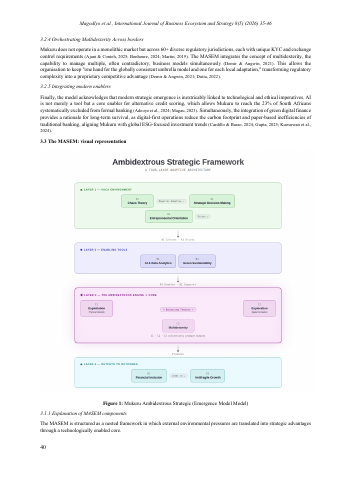
- Multidexterity allows financial entities to orchestrate globally consistent umbrella models while running tailored business models across 60+ distinct regulatory jurisdictions.p.6
- AI credit scoring using alternative data provides a viable path to bring unbanked populations into formal credit ecosystems.p.8
- Establishing governance and ethical frameworks around AI usage is necessary to handle regulatory diversity across African markets.p.9
- Transitioning customers from remittance sending to credit and savings channels builds long-term organizational antifragility.p.10
Pages
 p.1
 p.2
 p.3
 p.4
 p.5
 p.6
 p.7
 p.8
 p.9
 p.10
 p.11
 p.12
Topics and entities
Summary and figures generated from the document and checked automatically: every number shown appears on the cited page. Publishers can request removal.