Embedded Supervision for Intellectual Property Tokenisation Under the EU DLT Pilot Regime: Reconciling Proportionality with Trade Secret Protection (Advances in Social Behavior Research)
Summary
- Regulation (EU) 2022/858 establishes a pilot regime allowing financial market infrastructures to test DLT financial instruments subject to regulatory oversight.p.2
- Article 3 limits DLT share issuances to issuers with a market capitalisation below EUR 500 million.p.5
- Article 3 caps DLT bonds and securitised debt issuances at an issue size below EUR 1 billion.p.5
- Under Article 4(3), competent authorities are granted direct access to transaction details as regulatory observer participants when exempted from Article 26 MiFIR reporting.p.6
- Article 2(1) of Directive (EU) 2016/943 requires trade secret holders to take reasonable steps to maintain secrecy, which unencrypted ledger storage could jeopardize.p.8
- Article 25 GDPR mandates data protection by design and data minimisation for technical architectures processing regulated data.p.10
Key insights
- Settlement efficiency for tokenised intellectual property depends directly on whether CBDCs, stablecoins, or tokenised bank deposits serve as the on-chain payment asset.p.3
- Intellectual property tokens qualify for the EU DLT Pilot Regime only if they satisfy the existing definition of a MiFID II financial instrument rather than being categorized under MiCA.p.5
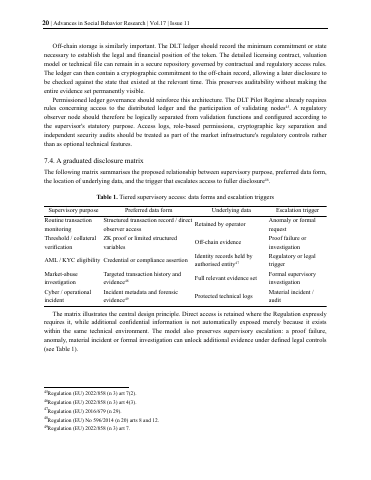
- Embedded supervision should be structured as graduated data access rather than granting regulators unrestricted visibility over all commercial data.p.7
- Publishing plaintext trade secret information on a distributed ledger can jeopardize legal protection under Article 2(1)(c) of Directive (EU) 2016/943.p.9
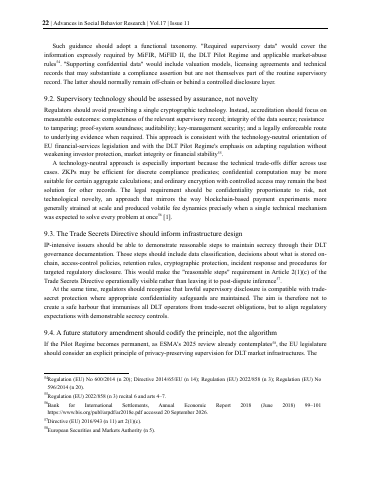
- The EU proportionality principle requires regulators to rely on the least intrusive supervisory interface available, such as zero-knowledge proofs.p.11
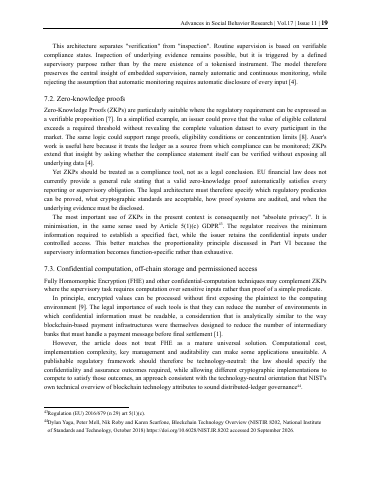
- A four-layer supervisory architecture separates public ledger settlement from permissioned supervisory access, zero-knowledge compliance, and off-chain evidence storage.p.12
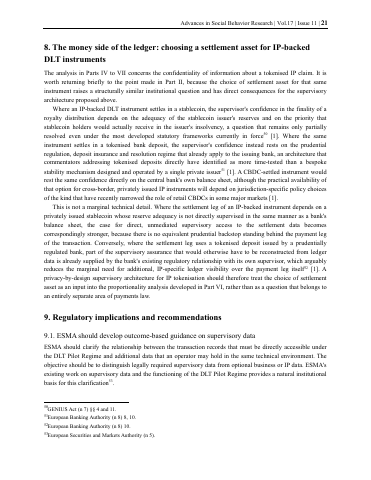
- Settling IP transactions using tokenised bank deposits leverages established prudential backstops, reducing the need for intrusive supervisory visibility over payment legs.p.15
Pages
 p.1
 p.2
 p.3
 p.4
 p.5
 p.6
 p.7
 p.8
 p.9
 p.10
 p.11
 p.12
 p.13
 p.14
 p.15
 p.16
 p.17
 p.18
 p.19
Topics and entities
Summary and figures generated from the document and checked automatically: every number shown appears on the cited page. Publishers can request removal.