Digital Disruption in Insurance and Skills Development: Advancing the INSETA Mandate: A Conceptual Review of Technology-Driven Workforce Transformation in the Global and African Insurance Sector (Journal of Strategic Management)
Summary
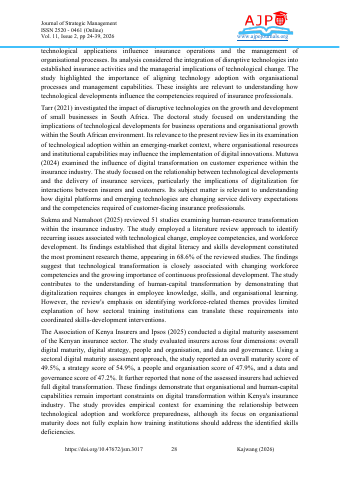
- A literature review of 51 studies on insurance human-resource transformation revealed that digital literacy and skills development was the most prominent research theme, appearing in 68.6% of publications.p.6
- An assessment of Kenyan insurers by AKI/Ipsos (2025) recorded an overall sectoral digital maturity score of 49.5%, with people and organisation scoring 47.9%.p.6
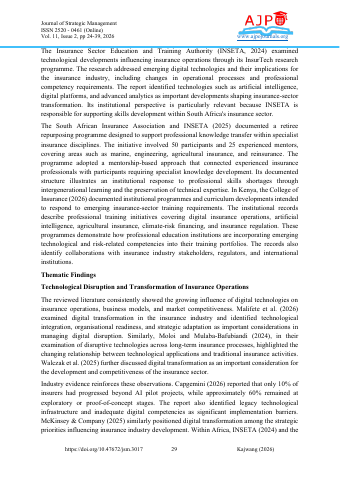
- Global research by Capgemini (2026) shows that only 10% of insurers have progressed beyond AI pilot projects, while about 60% remain at proof-of-concept stages.p.7
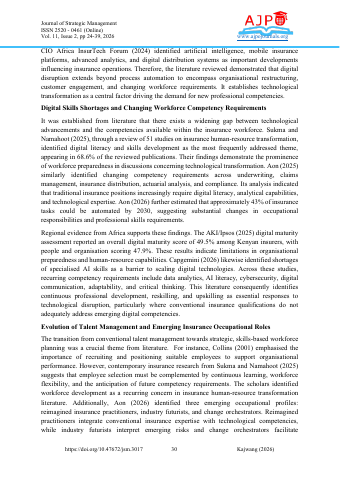
- Task automation analysis by Aon (2026) estimates that approximately 43% of insurance tasks could be automated by 2030.p.8
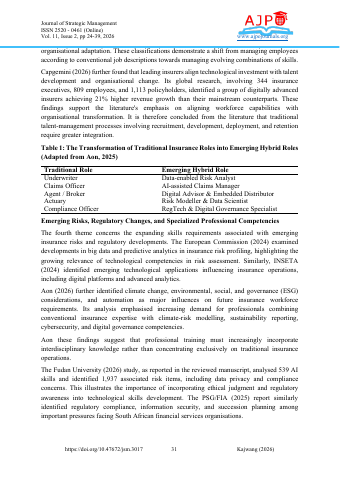
- Digitally advanced insurers achieve 21% higher revenue growth than mainstream industry competitors according to global research across 344 insurance executives.p.9
- A study by Fudan University (2026) identified 1,937 risk items associated with 539 analyzed AI skills in public insurance.p.9
- African digital insurance capacity is projected to reach USD 166 billion by 2034, driven primarily by mobile-first platforms.p.13
Key insights
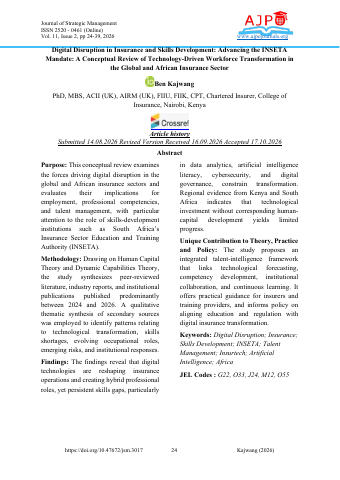
- Technological investment without corresponding human-capital development produces limited progress in insurance sector transformation.p.2
- Digital literacy and skills development represent the primary focus of insurance workforce transformation research, present in 68.6% of reviewed studies.p.6
- Legacy systems and shortages of specialized AI skills constrain roughly 60% of insurers to early exploratory stages of AI adoption.p.7
- Automation will reshape roughly 43% of insurance tasks by 2030, driving the creation of hybrid roles combining technical, behavioral, and regulatory skills.p.8
- Insurers that align technological investments with structured talent development generate 21% higher revenue growth than mainstream peers.p.9
- Emerging AI competencies in insurance introduce significant compliance and privacy risks, requiring integrated regulatory and ethical training.p.9
- Kenya's digital insurance ecosystem leverages mobile infrastructure for financial inclusion, whereas South Africa's market emphasizes operational efficiency and claims automation.p.13
Pages
 p.1
 p.2
 p.3
 p.4
 p.5
 p.6
 p.7
 p.8
 p.9
 p.10
 p.11
 p.12
 p.13
 p.14
 p.15
 p.16
 p.17
Topics and entities
Summary and figures generated from the document and checked automatically: every number shown appears on the cited page. Publishers can request removal.