Analysis of the Concepts and Application of Murabahah and Musyarakah Financing in Islamic Banking (CASHFLOW CURRENT ADVANCED RESEARCH ON SHARIA FINANCE AND ECONOMIC WORLDWIDE)
Summary
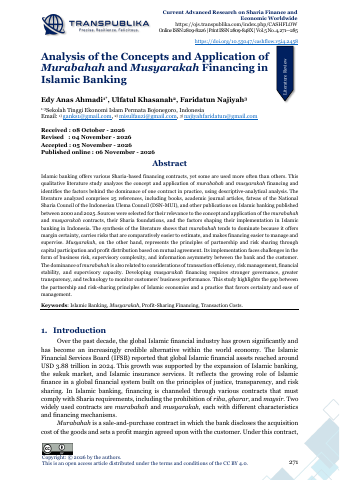
- Global Islamic financial assets reached around USD 3.88 trillion in 2024 according to the Islamic Financial Services Board (IFSB).p.1
- The study conducts a literature review of 25 references published between 2000 and 2025, focusing on Sharia foundations and contract implementation.p.1
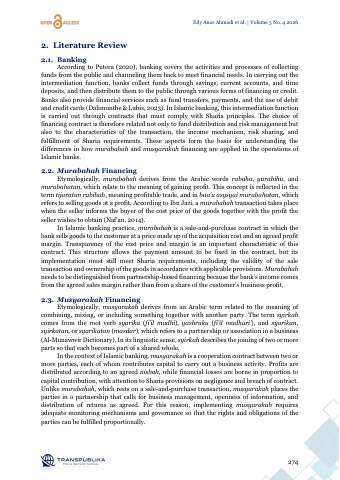
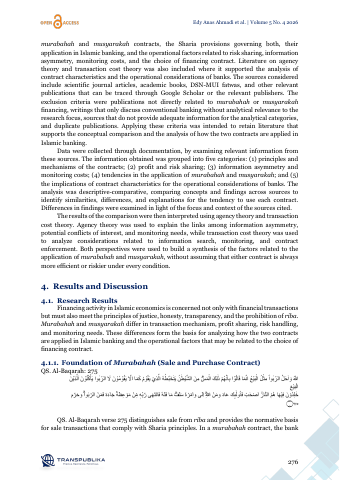
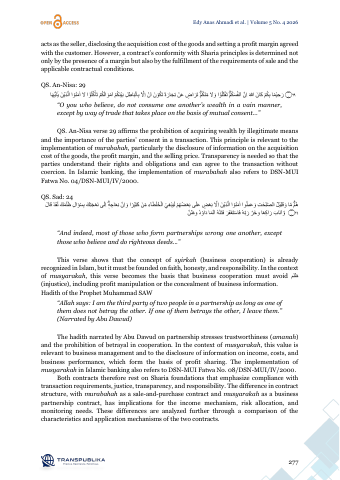
- Murabahah functions as a sale-and-purchase contract with fixed prices and margins, referencing DSN-MUI Fatwa No. 04/DSN-MUI/IV/2000 in Indonesian banking.p.7
- Musyarakah acts as a capital partnership contract governed in Indonesia under DSN-MUI Fatwa No. 08/DSN-MUI/IV/2000.p.7
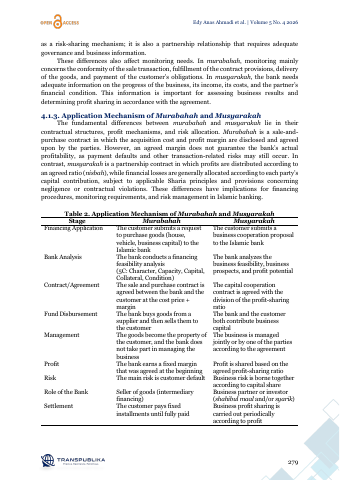
- Murabahah bank feasibility analysis evaluates customer applications using 5C parameters: Character, Capacity, Capital, Collateral, and Condition.p.9
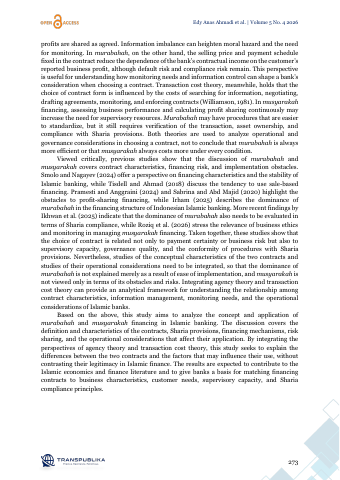
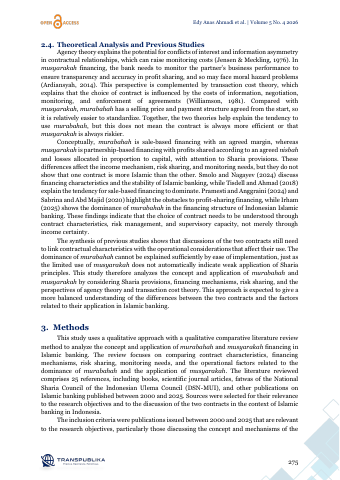
- Theoretical analysis combines agency theory and transaction cost theory to examine information asymmetry and monitoring requirements in Islamic financing.p.3
Key insights
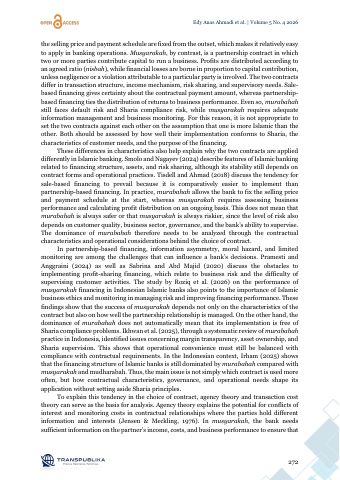
- Murabahah tends to dominate Islamic banking operations because it provides margin certainty, predictable payment schedules, and lower supervisory complexity.p.1
- Musyarakah implementation faces structural challenges including ongoing business risk, supervisory difficulty, and information asymmetry between banks and partners.p.1
- Agency theory explains that musyarakah partners may encounter potential moral hazard, requiring continuous verification of business performance and profits.p.5
- Transaction cost theory indicates murabahah procedures are easier to standardize, although banks still incur costs for feasibility and Sharia compliance verification.p.5
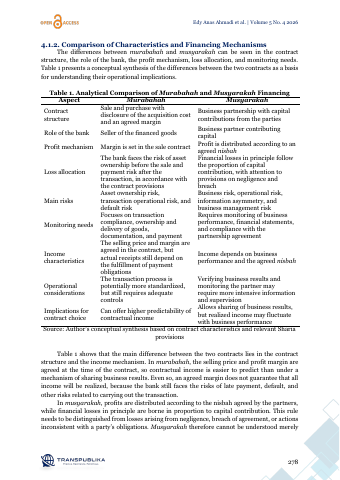
- Fixed contractual margins in murabahah financing do not eliminate earnings risk, as banks remain exposed to customer default and late payments.p.10
- Financial losses in musyarakah are allocated strictly according to capital contribution proportions, provided no negligence or contractual breach occurs.p.4
Pages
 p.1
 p.2
 p.3
 p.4
 p.5
 p.6
 p.7
 p.8
 p.9
 p.10
 p.11
 p.12
 p.13
 p.14
 p.15
Topics and entities
Summary and figures generated from the document and checked automatically: every number shown appears on the cited page. Publishers can request removal.