Analysis of Big Data-Based Financial Technology and AI on Financial Inclusion in Indonesia (EKOMBIS REVIEW Jurnal Ilmiah Ekonomi dan Bisnis)
Summary
- The study analyzes the impact of Big Data and AI-based financial technology on expanding financial inclusion across Indonesian provinces for the 2019–2024 period.p.1
- Indonesia's national financial inclusion index increased from 67.8% in 2016 to 85.1% in 2022.p.2
- A persistent gap remains between financial access and financial literacy, which stood at 49.68% in 2022.p.2
- Indonesia set a national target to achieve a 90% financial inclusion rate by 2024.p.3
- The empirical panel data regression model shows an Adjusted R-Squared of 86.54%, indicating high explanatory power for financial inclusion drivers.p.9
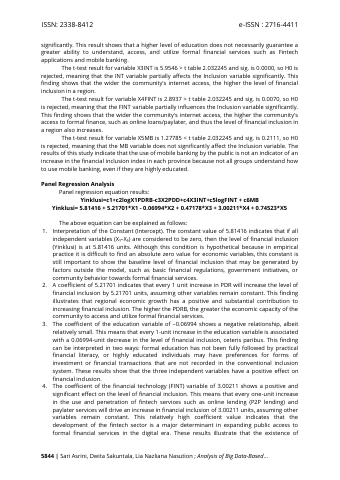
- Fintech loan adoption demonstrates a strong positive contribution to financial inclusion with a regression coefficient of 3.00211.p.8
Key insights
- Big Data and AI enhance financial inclusion by expanding credit distribution efficiency and providing non-traditional credit scoring.p.1
- The national financial inclusion index in Indonesia rose from 67.8% in 2016 to 85.1% in 2022.p.2
- Financial literacy levels in Indonesia lag behind inclusion at 49.68%.p.2
- Indonesia targeted reaching a 90% financial inclusion rate by 2024.p.3
- The tested independent variables collectively explain 86.54% of the variation in Indonesia's financial inclusion index.p.9
- Fintech penetration acts as a key driver of financial inclusion with a positive regression coefficient of 3.00211.p.8
- Mobile banking penetration positively impacts the financial inclusion index with a regression coefficient of 0.74523.p.8
- Regional economic growth measured by GRDP shows a positive coefficient of 5.21701 on financial inclusion.p.8
Pages
 p.1
 p.2
 p.3
 p.4
 p.5
 p.6
 p.7
 p.8
 p.9
 p.10
 p.11
 p.12
 p.13
 p.14
Topics and entities
Summary and figures generated from the document and checked automatically: every number shown appears on the cited page. Publishers can request removal.