Adaptive Management in Modern Banks to Prevent Cross-Border Money Laundering (Український економічний часопис)
Summary
- In 2024, China recorded a record $168 billion outflow of foreign direct investment amid tightening currency movement restrictions.p.2
- Current regulatory restrictions in China enforce an annual $50,000 limit on foreign currency conversion for individuals.p.2
- FinCEN reported that US institutions flagged $312 billion in suspicious transactions connected to Chinese money laundering networks between 2020 and 2024.p.2
- The US State Department estimates that $154 billion in illicit funds flow annually through Chinese shadow banking channels.p.2
- Traditional deterministic compliance algorithms remain highly vulnerable to horizontal networks, P2P retail account fragmentation, and informal mirror transfers.p.1
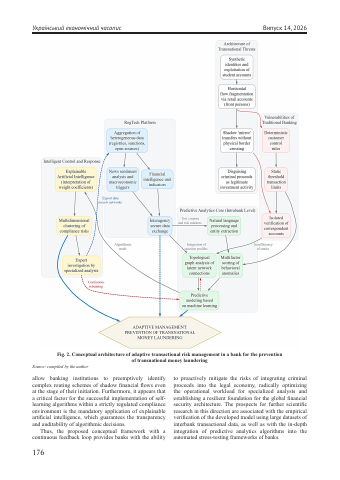
- An adaptive compliance architecture merges internal bank analytics with macro-level RegTech data and explainable artificial intelligence to preemptively detect illicit financial flows.p.1
Key insights
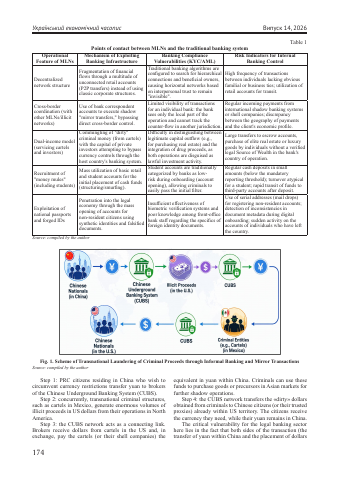
- Deterministic compliance algorithms fail to detect horizontal money laundering networks because they are configured to look for hierarchical corporate structures.p.3
- Correspondent accounts are used to execute shadow mirror transfers where individual banks can only observe local operations without visibility into cross-border counter-flows.p.3
- Money laundering networks exploit student and retail accounts during initial onboarding due to low perceived risk, enabling rapid fund transit via smurfing.p.3
- The Chinese Underground Banking System pairs private citizens seeking capital outflow with criminal organizations needing dollar laundering through mirror transactions.p.3
- Topological graph analysis and behavioral anomaly scoring inside the intrabank analytics core allow banks to uncover hidden routing schemes.p.4
- State-level RegTech platforms supply banking algorithms with macro triggers, sanction profiles, and textual risk markers without replacing autonomous internal scoring.p.4
- Explainable artificial intelligence provides transparent interpretation of model weight coefficients, ensuring algorithmic decisions remain auditable for regulators.p.4
- Continuous feedback loops within the adaptive monitoring framework enable real-time model retraining based on analyst investigation outcomes.p.4
Pages
 p.1
 p.2
 p.3
 p.4
 p.5
 p.6
 p.7
Topics and entities
Summary and figures generated from the document and checked automatically: every number shown appears on the cited page. Publishers can request removal.