Tax aggressiveness and business risk: how does firm performance affect their relationship? (Revista de Educação e Pesquisa em Contabilidade (REPeC))
Summary
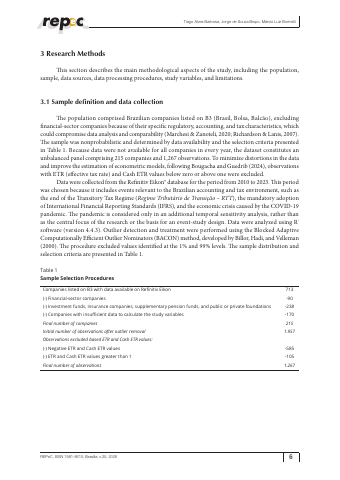
- The final study sample comprises 215 non-financial companies listed on B3 with 1,267 observations from 2010 to 2023.p.6
- Data filtering removed 585 observations with negative effective tax rates and 105 observations with rates exceeding 1.p.6
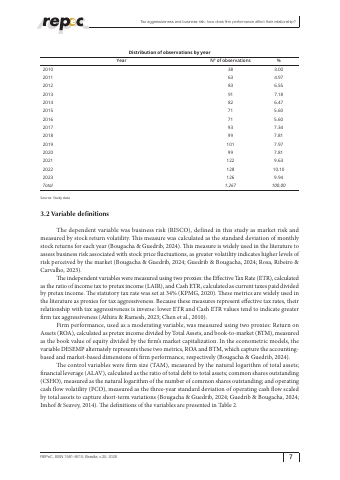
- The statutory corporate tax rate benchmark applied in the research framework is 34%.p.7
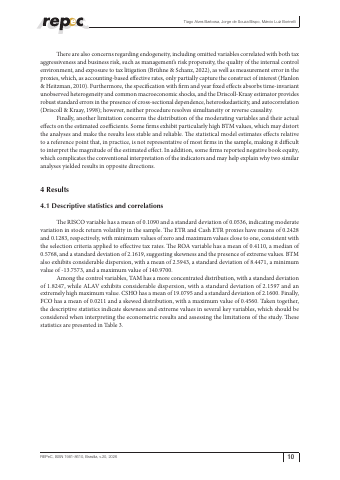
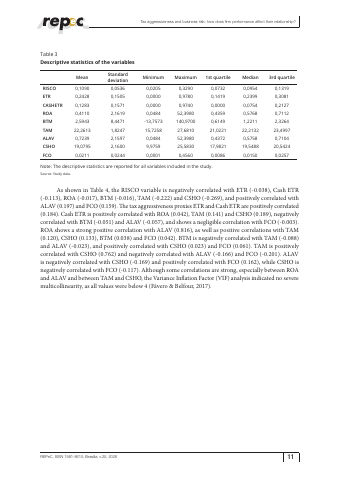
- Descriptive statistics report a sample mean effective tax rate (ETR) of 0.2428 and an average Cash ETR of 0.1283.p.10
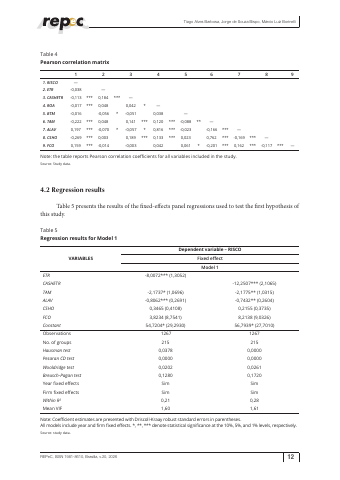
- In Model 1 regression, the ETR coefficient is -8.0072 and the Cash ETR coefficient is -12.2507, linking lower effective tax rates to greater market risk.p.12
Key insights
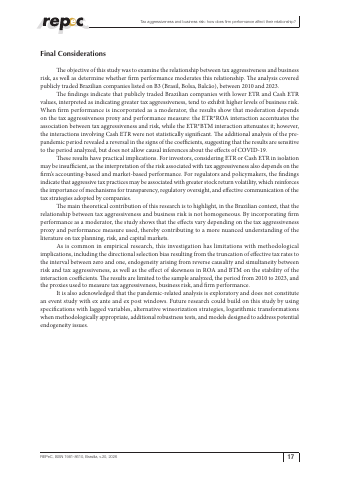
- Lower ETR and Cash ETR values, indicating greater tax aggressiveness, are associated with higher stock return volatility among Brazilian listed firms.p.1
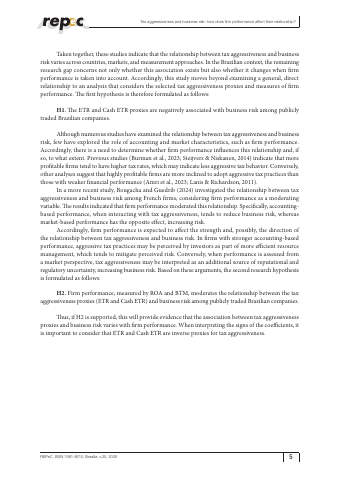
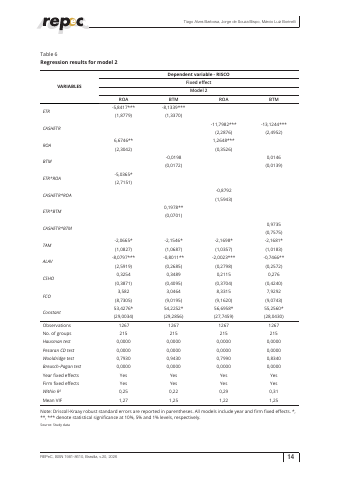
- Accounting performance measured by ROA strengthens the association between lower effective tax rates and higher business risk.p.1
- Market performance measured by book-to-market (BTM) weakens the negative relationship between ETR and business risk.p.1
- Interaction terms between Cash ETR and firm performance measures show no statistical significance in the full panel regressions.p.15
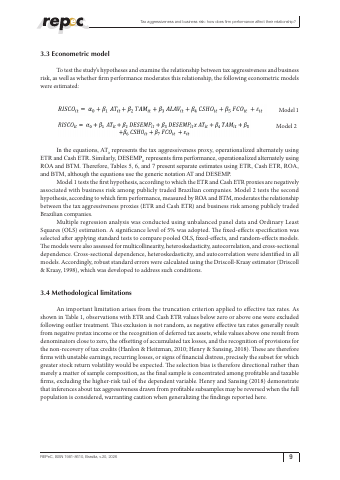
- Excluding firms with ETR values below zero or above one introduces a directional selection bias by removing firms in financial distress.p.9
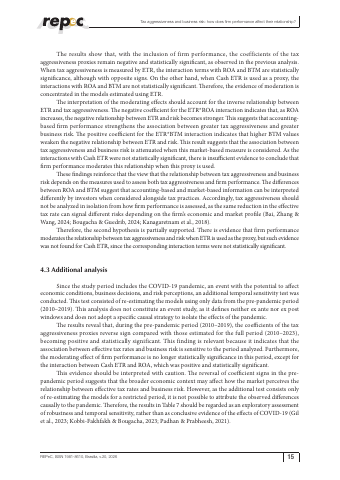
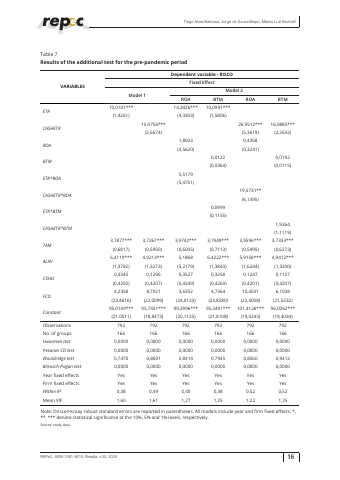
- In the pre-pandemic subsample from 2010 to 2019, the tax aggressiveness coefficients reverse sign to positive values.p.15
- Larger firm size and financial leverage are significantly associated with reduced stock return volatility in Model 1 regressions.p.13
Pages
 p.1
 p.2
 p.3
 p.4
 p.5
 p.6
 p.7
 p.8
 p.9
 p.10
 p.11
 p.12
 p.13
 p.14
 p.15
 p.16
 p.17
 p.18
 p.19
 p.20
 p.21
Topics and entities
Summary and figures generated from the document and checked automatically: every number shown appears on the cited page. Publishers can request removal.