Sustainability Investing in Family Offices: Evidence from Singapore (Journal of Sustainability)
Summary
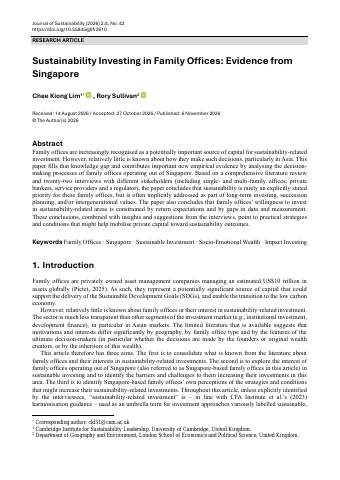
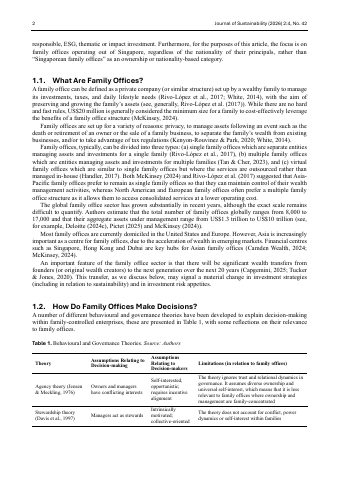
- Family offices globally manage an estimated US$10 trillion in assets, with total sector numbers ranging from 8,000 to 17,000.p.2
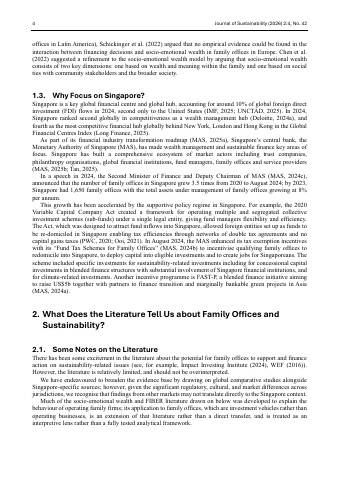
- The number of family offices in Singapore expanded 3.5 times from 2020 to August 2024, reaching 1,650 family offices by 2023.p.4
- The study evaluates Singapore-based decision-making using evidence from 22 qualitative interviews across family offices, banks, service providers, and a regulator.p.6
- Financial performance dominates decision-making, with 18 of 19 family office and banking interviewees identifying wealth preservation as a primary objective.p.7
- Over half of all interviewees cited persistent gaps in data and measurement as primary barriers to expanding sustainability investments in private markets.p.10
Key insights
- Wealth preservation and wealth growth represent the core investment priorities for family offices operating out of Singapore.p.7
- Family offices separate financial objectives from purpose-driven goals, addressing social impact primarily through philanthropy rather than concessionary investing.p.8
- Singapore-based family offices execute sustainability-related investments only when those deals meet standard commercial return expectations.p.8
- Next-generation family members drive discussions around sustainability, but their influence depends on their recognized financial literacy and investment competence.p.9
- Family offices are generally unwilling to accept below-market risk-adjusted returns to achieve specific environmental or social sustainability outcomes.p.9
- The absence of quality sustainable deals and unproven track records present major hurdles to allocating capital into sustainable strategies.p.9
- Data gaps and non-standardized sustainability reporting in private markets hamper accurate risk and performance assessments.p.10
- Regulatory incentives and reputational considerations play a secondary role compared to deal quality and target financial returns.p.10
Pages
 p.1
 p.2
 p.3
 p.4
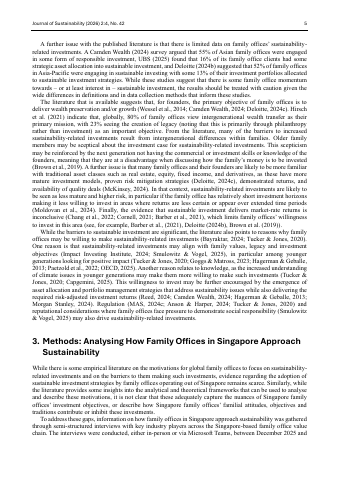 p.5
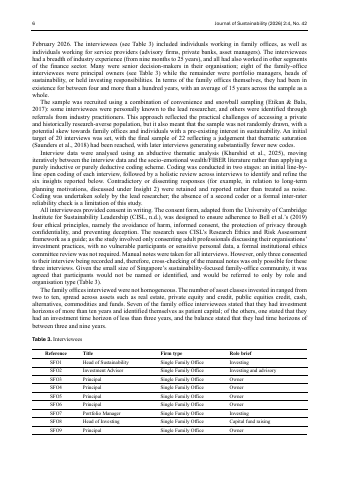 p.6
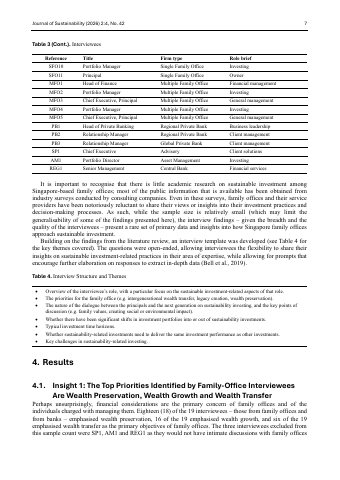 p.7
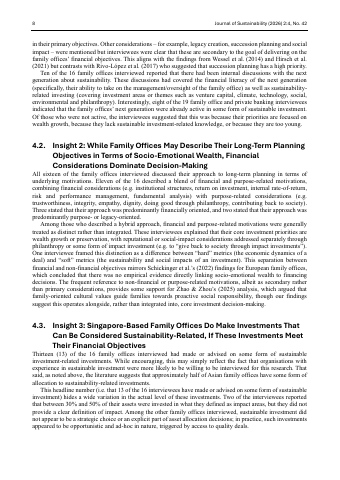 p.8
 p.9
 p.10
 p.11
 p.12
 p.13
 p.14
 p.15
Topics and entities
Summary and figures generated from the document and checked automatically: every number shown appears on the cited page. Publishers can request removal.