Strengthening Financial Integrity through Blockchain Governance: A Framework for Transparent Digital Asset Regulation (British Journal of Multidisciplinary and Advanced Studies)
Summary
- By 2025, the market capitalisation of digital assets exceeded $2 trillion, with daily trading volumes matching traditional stock markets.p.2
- The 2022 crypto winter erased over $1 trillion in value and caused major losses for retail investors.p.2
- Illicit flows in virtual assets were estimated to exceed $20 billion annually in 2024.p.2
- On-chain fraud and scam activity accounted for over $51 billion according to the FATF 2025 Targeted Update.p.5
- Automated protocol-based tracing and screening can decrease the number of illicit transactions by 40%.p.8
- Implementation gaps regarding FATF virtual asset standards persist across 117 jurisdictions.p.13
Key insights
- Traditional entity-based financial regulations struggle to govern borderless, pseudonymous, and automated blockchain networks.p.2
- A multi-layered governance framework embeds compliance directly into protocol code, network validators, and entity operations.p.3
- The inherent auditability of public blockchains enables regulators to focus on verifiable intelligence rather than data collection.p.6
- Decentralised finance protocols bypass central intermediaries, causing enforcement gaps under traditional AML and CFT rules.p.5
- Programmable compliance modules, including sanctions screening oracles, can automatically detect and block illegal flows at the origin.p.9
- Positioning regulators as super-nodes allows real-time supervisory monitoring via zero-knowledge proofs without violating privacy laws.p.10
- Cross-chain bridges, privacy coins, and mixers present serious technical and jurisdictional barriers to digital asset enforcement.p.12
- Regulatory fragmentation across countries leads to regulatory arbitrage and market volatility.p.13
Pages
 p.1
 p.2
 p.3
 p.4
 p.5
 p.6
 p.7
 p.8
 p.9
 p.10
 p.11
 p.12
 p.13
 p.14
 p.15
 p.16
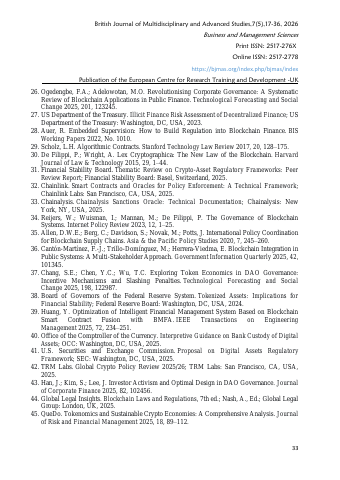 p.17
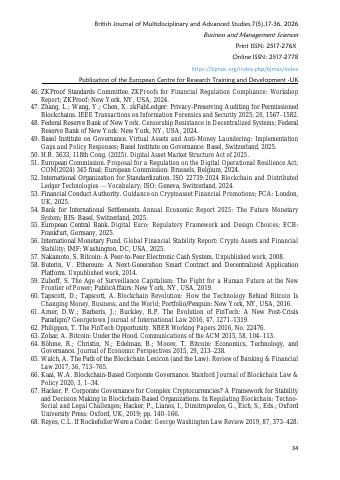 p.18
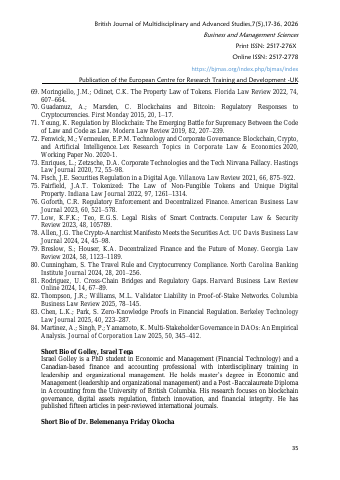 p.19
 p.20
Topics and entities
Summary and figures generated from the document and checked automatically: every number shown appears on the cited page. Publishers can request removal.