Does Institutional Quality Condition the Contribution of Foreign Direct Investment to Economic Growth in the ECCAS? (Journal of economics, business and commerce.)
Summary
- Net foreign direct investment flows to the ECCAS region declined to approximately -$0.1 billion in 2022, down from around $2 billion in 2017.p.2
- Inward FDI flows to Central Africa rose from $7.017 billion in 2023 to $7.907 billion in 2024, representing an increase of 12.7%.p.2
- Economic growth in the CEMAC subregion decelerated from 3.1% in 2022 to 1.7% in 2023.p.2
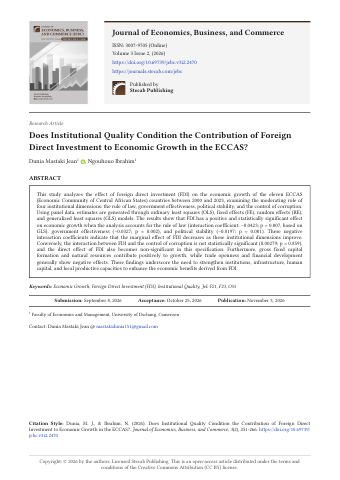
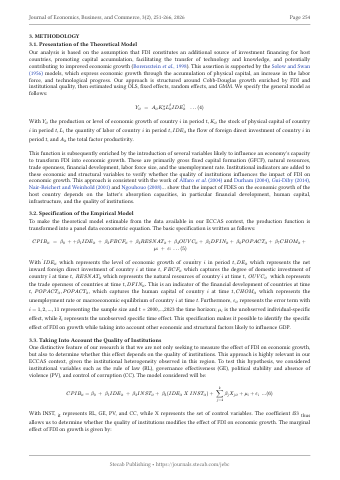
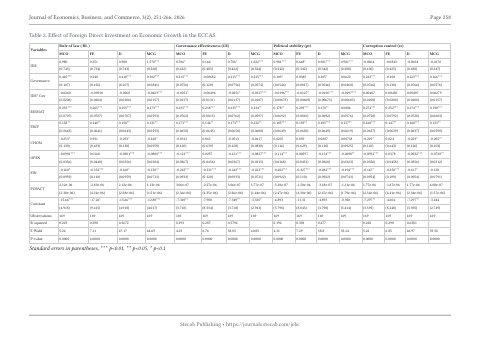
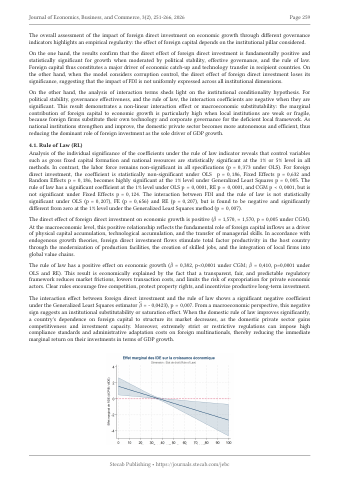
- Under GLS estimation, the interaction coefficient between FDI and the rule of law is -0.0423 (p = 0.007).p.1
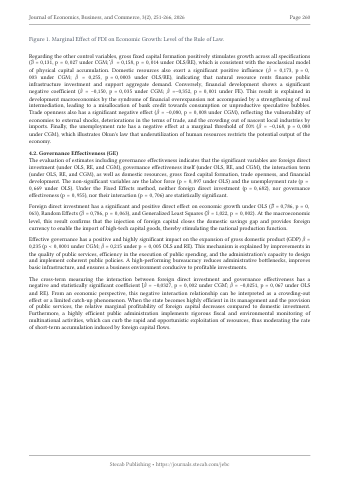
- The interaction coefficient between FDI and government effectiveness stands at -0.0327 (p = 0.002) in the GLS specification.p.1
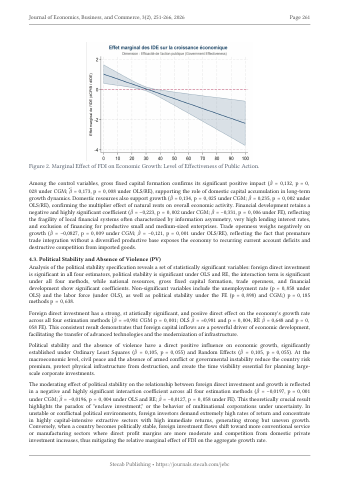
- FDI interacts with political stability yielding a GLS interaction coefficient of -0.0197 (p = 0.001).p.1
Key insights
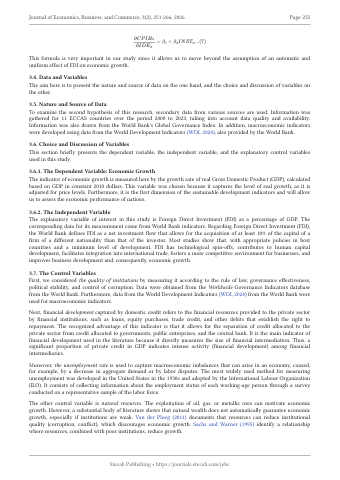
- Foreign direct investment exerts a positive and statistically significant direct effect on economic growth when moderated by rule of law, government effectiveness, and political stability.p.10
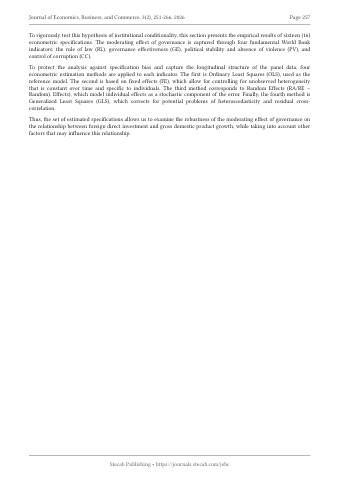
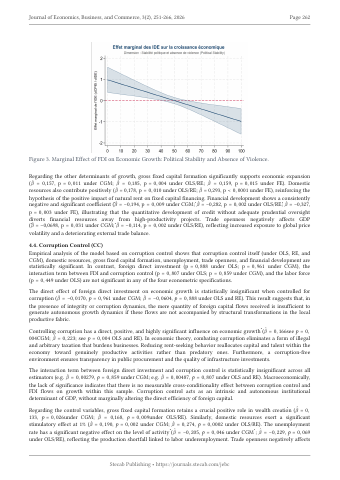
- Negative interaction coefficients between FDI and institutional indicators reflect a substitutability effect where FDI's marginal impact is highest in weak institutional settings.p.10
- The interaction between FDI and corruption control is statistically non-significant at 0.00279 (p = 0.859), indicating no measurable cross-conditionality.p.1
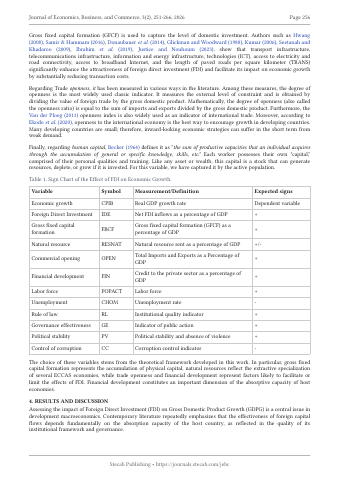
- Gross fixed capital formation and natural resource rents consistently generate positive contributions to GDP growth across empirical models.p.1
- Financial development exhibits a negative relationship with growth in the region due to credit misallocation toward unproductive consumption.p.11
- Trade openness impacts growth negatively in ECCAS countries owing to vulnerability to external price volatility and structural trade deficits.p.11
- Corruption control directly promotes economic growth with a statistically significant coefficient of 0.166 (p < 0.01) independent of FDI interactions.p.14
Pages
 p.1
 p.2
 p.3
 p.4
 p.5
 p.6
 p.7
 p.8
 p.9
 p.10
 p.11
 p.12
 p.13
 p.14
 p.15
 p.16
 p.17
Topics and entities
Summary and figures generated from the document and checked automatically: every number shown appears on the cited page. Publishers can request removal.