Digital Green Bonds and ESG-Linked FinTech Platforms: Democratizing Sustainable Finance in Emerging Economies (Advanced International Journal of Multidisciplinary Research)
Summary
- The research analyzes digital green bonds and ESG-linked platforms through 3 theoretical lenses: financial inclusion theory, institutional innovation theory, and sustainability transition framework.p.3
- Digital green bonds operate across 3 conceptual planes comprising transparency, accessibility, and normativity.p.4
- ESG-linked FinTech platforms contrast with traditional FinTech solutions in 2 main aspects: normative orientation and analytical integration.p.5
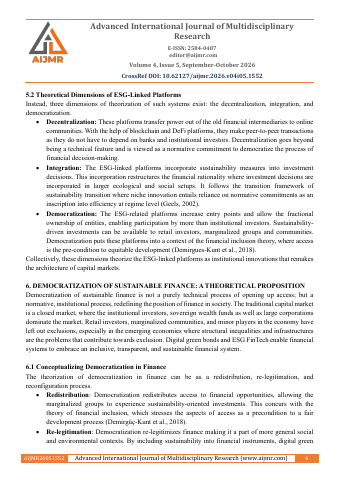
- Democratization of sustainable finance is theorized as a process structured around 3 dimensions: redistribution, re-legitimation, and reconfiguration.p.6
- Academic literature highlights aggregated evidence from more than 2000 empirical studies on ESG and financial performance.p.13
- Global Findex data from 2017 underscores the role of fintech solutions in expanding access to marginalized financial groups.p.13
Key insights
- Digital green bonds utilize blockchain and distributed ledger systems to lower transaction costs, improve verifiable fund allocation, and allow retail investors access via fractional ownership.p.4
- ESG-linked FinTech platforms combine sustainability analytics, crowdfunding mechanisms, and decentralized finance to redirect capital towards verifiable ESG standards.p.5
- Institutional innovation theory demonstrates that integrating sustainability into bond issuance redefines governance models from pure profit maximization toward ecological accountability.p.3
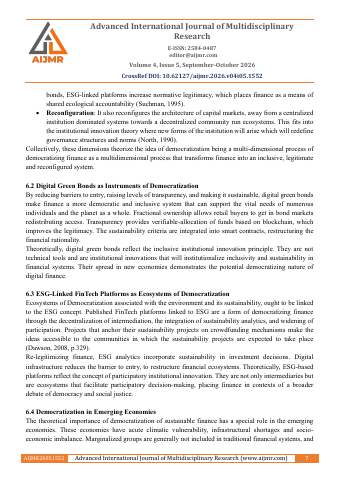
- Emerging economies benefit from digital sustainable finance as it lowers entry barriers and addresses structural inequalities alongside climate vulnerability.p.4
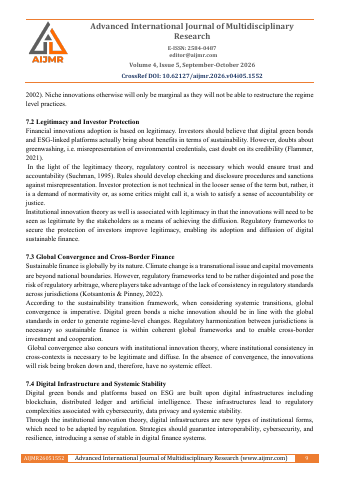
- Greenwashing poses a major threat to institutional legitimacy and investor trust, requiring rigorous independent verification and standardized disclosure frameworks.p.10
- The digital divide risks perpetuating structural exclusion for rural communities, women, and lower-income populations who lack digital access.p.11
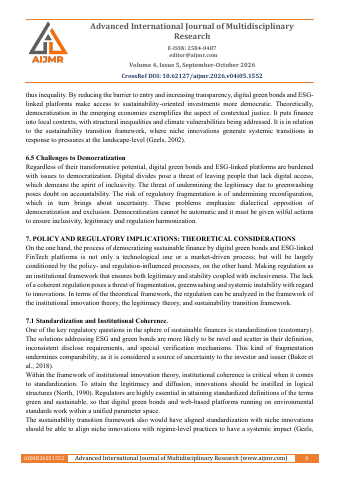
- Regulatory fragmentation across jurisdictions creates risks of regulatory arbitrage, emphasizing the necessity of global convergence and standardization.p.11
Pages
 p.1
 p.2
 p.3
 p.4
 p.5
 p.6
 p.7
 p.8
 p.9
 p.10
 p.11
 p.12
 p.13
Topics and entities
Summary and figures generated from the document and checked automatically: every number shown appears on the cited page. Publishers can request removal.