Analysis of the Application of Information Obligations and Transparency in Consumer Protection of Crypto Asset Investment (International Journal of Health Economics and Social Sciences (IJHESS))
Summary
- Crypto asset transaction volume in Indonesia reached IDR 482.23 trillion throughout 2025 amid expanding supervisory oversight.p.2
- The count of crypto investors in Indonesia grew to 21.7 million as of April 2026, exceeding the number of conventional mutual fund investors.p.2
- Under Government Regulation Number 49 of 2024, supervisory authority for digital financial assets officially shifted from Bappebti to OJK on January 10, 2025.p.2
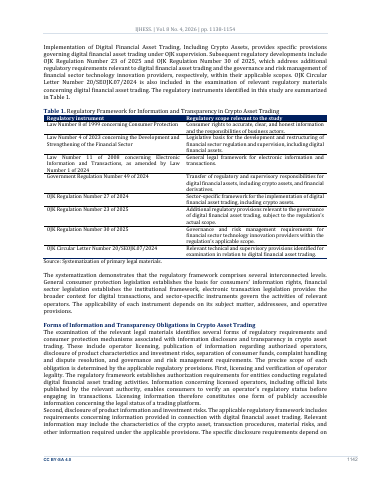
- The research framework evaluates primary statutes including Law Number 8 of 1999, Law Number 4 of 2023, and sector-specific Financial Services Authority regulations.p.4
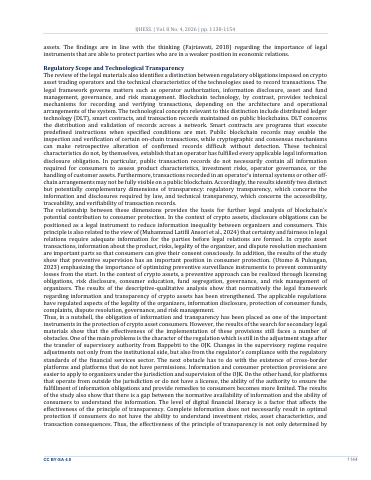
- While distributed ledger technology and smart contracts enhance transaction traceability, they cannot independently guarantee legal compliance or product quality.p.3
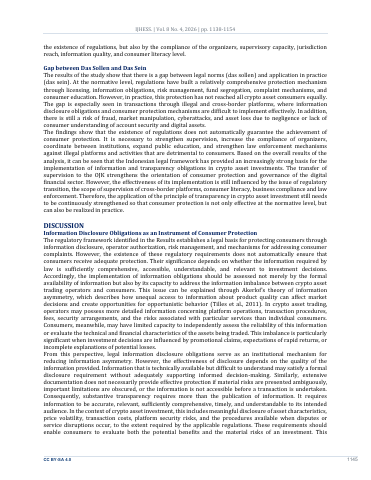
- The report highlights a gap between normative regulatory requirements and practical protection, particularly regarding unauthorized cross-border platforms.p.8
Key insights
- Crypto asset transactions in Indonesia generated IDR 482.23 trillion throughout 2025 under increasingly stringent regulatory supervision.p.2
- Indonesia counted 21.7 million crypto investors as of April 2026, surpassing the total number of conventional mutual fund investors.p.2
- The regulatory transfer of digital financial asset oversight from Bappebti to the Financial Services Authority took effect on January 10, 2025.p.2
- Information asymmetry remains a core risk factor, as platform operators hold superior information on operational mechanics, system security, and trading risks.p.2
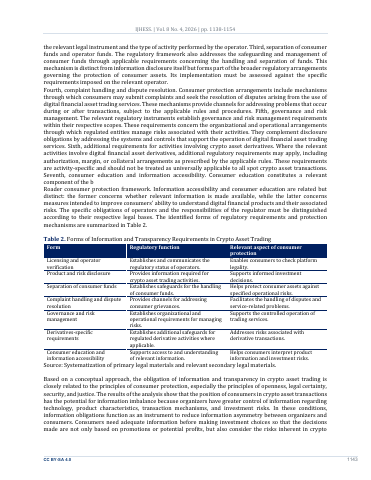
- Preventive legal protection relies on operator licensing, explicit risk disclosures, fund segregation, and governance standards to mitigate consumer losses beforehand.p.6
- Public blockchain transparency provides transactional auditability but fails to guarantee full product-risk disclosure or off-chain database accuracy.p.11
- Cross-border trading platforms operating outside Indonesian legal oversight complicate jurisdiction, dispute resolution, and enforcement mechanisms.p.3
- Embedded supervision and RegTech tools offer potential for real-time compliance monitoring on distributed ledgers if supported by robust legal access.p.11
Pages
 p.1
 p.2
 p.3
 p.4
 p.5
 p.6
 p.7
 p.8
 p.9
 p.10
 p.11
 p.12
 p.13
 p.14
 p.15
 p.16
 p.17
Topics and entities
Summary and figures generated from the document and checked automatically: every number shown appears on the cited page. Publishers can request removal.