Private Equity, Venture Capital at Work in Sweden 2026
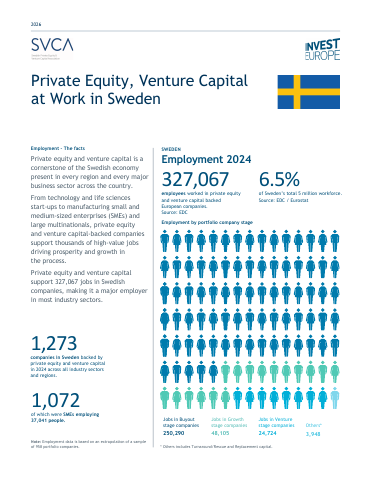
Private equity and venture capital backed companies supported 327,067 jobs in Sweden in 2024, representing 6.5% of the total 5 million workforce.
Industry association · SE · 19 documents · Website
Private equity and venture capital backed companies supported 327,067 jobs in Sweden in 2024, representing 6.5% of the total 5 million workforce.
The EU faces an annual investment gap of €750-800 billion to boost productivity, support the digital transition, and meet climate goals.
Private equity investments in Sweden reached SEK 133bn across 457 companies in 2025.
Productivity in Swedish companies receiving venture capital increased by 22% over a seven-year period.
Private equity portfolio companies directly and indirectly employ approximately 250 000 people, representing 4.8% of total employment in Sweden.
European venture capital firms receive an average of 851 investment proposals per year, with 6% leading to closed deals.
Mean FTE employment growth among SVCA member portfolio companies reached 21% in 2022, up from 9% in FY 2020.
Total private equity investments permanently increase Swedish GDP by 3.5%-4.7%.
A total of 60 PE backed IPOs occurred from the 10 th of December 2013 until the 6th of July 2022 and were analyzed in the study.
A negative impact from COVID-19 on portfolio companies was reported by 51% of private equity respondents, whereas 27% observed a positive impact.
SVCA member portfolio companies achieved a mean full-time equivalent (FTE) employment growth of 9% in 2020/2019 compared to 5% for all listed firms on Nasdaq OMX Stockholm.
The Swedish venture capital market represents 35% of total Nordic exit value and over SEK 35 billion in assets under management.
According to Copenhagen Economics analysis, Swedish GDP is currently 0.8% higher than it would otherwise be due to venture capital.
Venture capital (VC) funds invest in only around 0.2% of new U.S. businesses, yet 43% of U.S. public listed companies founded between 1979 and 2013 were VC-backed.
The long-term annual tax revenue expected from the proposal is overestimated by approximately SEK 160 million because it relies on a period of unusually high equity returns.
Stockholm attracted 18% of all European Fintech investments in 2014 and 16% over an 11-year period.
Skatteverket estimated that the proposed exit tax would increase annual Swedish tax revenues by around 1 billion kronor starting 1 January 2020.
In 2014, total invested equity in Swedish companies reached 8 100 billion SEK, with foreign owners accounting for 50 percent of the total.
Around 70,000 companies are founded each year in Sweden, but only a fraction are suitable for private equity and business angel investments.